Monday, July 31, 2006

Italian Students Visit the Library

Thanks to a tip by Louis Zanoni of WZBN, executive director Alex Magoun contacted Dr. Chiara Nappi of Princeton University's Physics Department to invite her summer course visitors to visit the Library. They appeared, all 46 including chaperones, on Friday afternoon, July 28. Alex led them on a tour of Mr. Sarnoff's office and exhibits, during which they learned about his origins, his motivation, and his strategies for improving the world's ability to exchange information. Alex also explained how industrial physicists, chemists, and engineers manipulated electrons, light, and phosphors, in vacuum and then in solids, in order to accomplish Sarnoff's goals.

Here are two photos, courtesy of Mr. Zanoni, of the tour and the group:


Lectures, Exhibits Attract Great Crowds

Over 220 people attended the three lectures on Thomas Edison, Bell Laboratories, and David Sarnoff last month in Sarnoff Corporation's Auditorium. Besides engaging with the speakers--Drs. Paul Israel, Sheldon Hochheiser, and Alexander Magoun--they also took in the new exhibits on David Sarnoff and the Innovative Spirit and Six Innovations that Changed the World. The lectures and exhibits were made possible in part by a project grant from the New Jersey Council for the Humanities, an operating support grant from the New Jersey Historical Commission, and the support of Mr. Arthur Sarnoff.

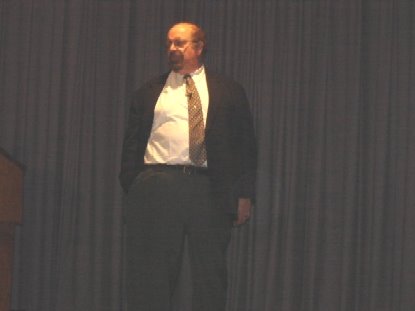
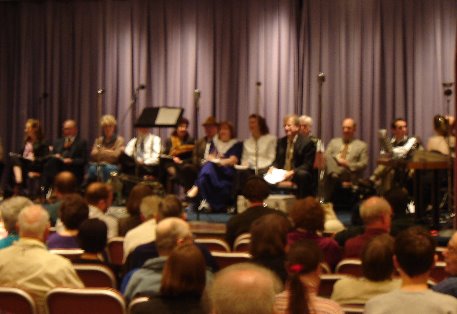
Here's Dr. Hochheiser on-stage, and one of the slides highlighting Claude Shannon and information theory as one of Bell Labs' signal contributions to the world in which we live:


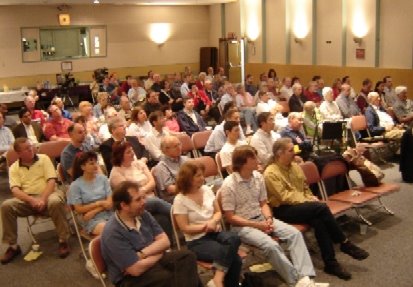
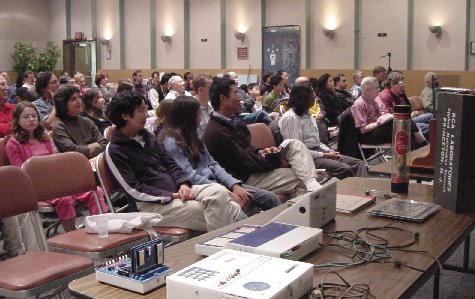
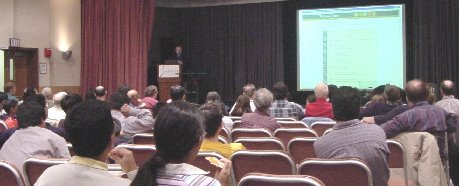
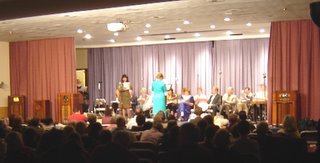
Here's the audience for Sheldon Hochheiser's lecture on Looking Down from Murray Hill: Six Innovations that Changed the World, on Tuesday, June 13:


Videographer Dave Sica of Sica Productions generously donated his time and skills to filming the lecture. Thanks to him and the equally generous Dave Hall of Davideo Multimedia, the three lectures will be made available on-line; for now, you can watch Dr. Hochheiser on Google Video here!

The exhibits involved renovating the artifact displays and mounting posters prepared by Alex Magoun, Sam Missimer of Venezia Associates, and Maria Mattera of Suite6 Design. On Saturday, May 20, Alex called on the strong backs of the New Jersey Antique Radio Club to remove the glass covers from the three main cases in the Library. In five hours he rearranged the exhibits to highlight Sarnoff's early career, video cameras, semiconductors, and computers.

On Memorial Day, Louise Grafton recovered the plinths in the five vertical cabinets with black, white, red, green, and blue fabric before Alex rearranged some of the contents. In particular, you can now see the first color TV picture tube and a signed baseball from the first night game broadcast in color between the Cincinnati Reds and the New York Giants on May 16, 1960 (the Reds won at Crosley Field, 9-2)

Finally, with the arrival of the posters portraying David Sarnoff's innovative spirit, carpenters Charlie Brzezynski and Bob Sanders of Sarnoff Corporation's Facilities crew installed mountings on the Library's columns to which the posters could be attached with velcro. Volunteer Phil Vourtsis helped fasten them on the level.

Our thanks to all above as well as Sarnoff Corporation's Lou Ann Wingerter for consulting on poster placement; Scott Marshall of Fedex Kinko's for sterling work in producing labels and mini-posters; and to Sharon Chapman for supervising refreshments and encouraging so many of the audience to fill out the NJCH's surveys after each lecture!

Thursday, May 11, 2006

Library Marks Sarnoff’s Centenary with Lectures, Exhibits

One hundred years ago, a fifteen-year-old immigrant started work as an office boy for the Marconi Wireless Telegraph Company of America, and the world changed because of it.

This June, the David Sarnoff Library will honor its namesake with three illustrated lectures and two exhibits on Sarnoff’s career and New Jersey innovations that changed the world. The lectures take place in Sarnoff Corporation’s Auditorium on successive Tuesday evenings on the 6th, 13th, and 20th of June, at 7:30 pm. These programs are made possible by grants from the New Jersey Council for the Humanities, a state partner of the National Endowment for the Humanities, and Sarnoff Corporation.

On June 6, Dr. Paul Israel, director of the Edison Papers at Rutgers University, will speak on “Looking Forward from Edison to RCA: Industrial Innovation in Central New Jersey.” He will discuss the geographic, economic, and human aspects that made the Garden State such an attractive location for the world’s greatest inventor and his research and development activities in the late 19th and early 20th centuries.

On June 13th, Dr. Sheldon Hochheiser, former historian and chief archivist for AT&T, will speak on “Looking Down from Murray Hill: Six Innovations that Changed the World.” He will explain why AT&T moved Bell Laboratories across the Hudson River from Manhattan, and discuss some of the innovations that emerged from them, from the transistor to satellite communications to digital networks.

On June 20th, Dr. Alexander Magoun, executive director of the David Sarnoff Library, will speak on “David Sarnoff, RCA, and the Arc of the American Century.” He will trace how Sarnoff’s career parallels the rise and relative decline of his adopted country, from his arrival from Russia in 1900 to the demise of the company he defined, RCA, in 1986.

“David Sarnoff is an icon of the American Dream,” says Dr. Magoun. “He’s Horatio Alger come to life, only we know that he accomplished far more than any of Alger’s children. The lectures and exhibits offer some context for why and how he and RCA’s staff accomplished so much.”

David Sarnoff rose through the ranks of Marconi and its successor, the Radio Corporation of America (RCA), and championed the innovation of electronic technologies to fill the human need for communications, from broadcast radio to color television to technologies enabling the Internet. In the summer of 1941, he helped break ground for what became the David Sarnoff Research Center at the junction of Routes 1 and 571 in Princeton. There, RCA’s scientists and engineers realized Sarnoff’s vision for more compact and convenient communications and information technologies by inventing and innovating color television, liquid-crystal displays, video cameras, low-power and high-frequency transistors, computers and memory technologies, and electron microscopy. Dedicated to improving opportunities through the innovation of electronic communications, Sarnoff and the inventors of RCA made possible a world connected and informed by electronics.

The exhibits—David Sarnoff and the Innovative Spirit and Six Innovations that Changed the World—visitors opportunities to understand and appreciate the electronic technologies that make modern life possible, and the people who brought them to life. Designed and produced by Venezia & Associates and Suite 6 Designs, they will remain on display for the rest of the year.

The Library will be open before and after the lectures to tour the exhibits. ADA access is available to the lectures. Refreshments will be served. For more information call (609) 734-2636 or email questions@davidsarnoff.org.

Tuesday, January 17, 2006

Digital Computing for Kids of All Ages, January 28

On, Off, AND, OR, NOT: That’s what computers are made of, according to Joyce Weisbecker. And she should know, both as a retired computer scientistand electronics engineer for Lockheed Martin and as the daughter of Joe Weisbecker, the inventor of RCA’s first personal computer in 1972. On Saturday, January 28, at 11 a.m. and 2 p.m. Ms. Weisbecker will explain the theory and practice of digital computing to children of all ages during the David Sarnoff Library’s openhouse and radio repair clinic.

“Personally, I like math,” she says, “but I know many people who don’t. If you can count to one, however, you know enough math for this talk. And if you can follow the logic of switching between AND, OR, and NOT, you can start building your own computer.” Co-sponsored by the New Jersey Antique Radio Club (NJARC), the open house will take place from 10 a.m. to 4 p.m. in Sarnoff Corporation’s auditorium and at the David Sarnoff Library, 201 Washington Road, Princeton, NJ.

The open house also features many other activities. The NJARC’s members don’t repair old computers—yet—but if you want your family heirloom radio repaired,the Radio Club offers a free clinic. Call (609) 734-2636 or email info@davidsarnoff.org with the brand and model number to make an appointment on the hour forone-on-one attention. Many vacuum-tube radios can be fixed in less than 60 minutes, and the Club’s experts will do it for free.

One hundred years ago, fifteen-year-old David Sarnoff began working as an office boy for the Marconi Wireless Telegraph Company of America. That same year,1906, Lee De Forest invented the vacuum-tube amplifier. The rest of the electronic century is history, and the Library’s executive director, Dr. Alex Magoun, will give a talk on David Sarnoff and the Innovative Spirit at 1 p.m. "David Sarnoff personifies the possibilities of the American Dream, from Hester Street to high technology," says Dr. Magoun. "There are few more inspiring stories than that of an immigrant who takes advantage of our freedoms of opportunity and expression toimprove himself and lead others in the creation of new technologies and industries that add to those freedoms."

And if you haven’t heard how good a theremin can sound in the hands of a master, come hear and see Kip Rosser play and explain the first electronic musical instrument in the Library’s museum. “Everyone says the theremin is incredibly difficult to play,” says Rosser. “Well, so’s the violin. If you have an ear and youpractice, you will improve.” Mr. Rosser plays a variety of jazz and pop from the last sixty years of the 20th century, and Dante Bucci will join him for some theremin duets from 10 a.m. to 1 p.m. and 2 to 4 p.m.

The Library’s exhibits offer opportunities for families to compare a century of home consumer media from Graphonolas to Aeriolas to televisions to Ipods. “Every generation has its own way of entertaining and educating itself with sight and sound,” says Dr. Magoun. “Introducing your children to these earlier formats is a greatway of connecting across generations.” The exhibits include a display on the 45-rpm record and player, the first transistor radio and television, a working 1948 television with camera, and a 1981 RCA VideoDisc player connected to a rare working model of RCA’s first color set, built in 1954. Remotes are not included.

The programs and museum are free admission although a suggested donation of five dollars per person is welcome.

The David Sarnoff Library is located at 201 Washington Road, east of Route 1, or at the end of Fisher Place off Route 1, just north of the Washington Road trafficcircle. For more information call 609-734-2636, or check the website at www.davidsarnoff.org/directions.htm. This event is made possible in part by an operating support grant from the New Jersey Historical Commission, a division of the Department of State; and the Friends of the David Sarnoff Library.

Looking Back at Fall Events III: NJ Historical Commission Honors Magoun


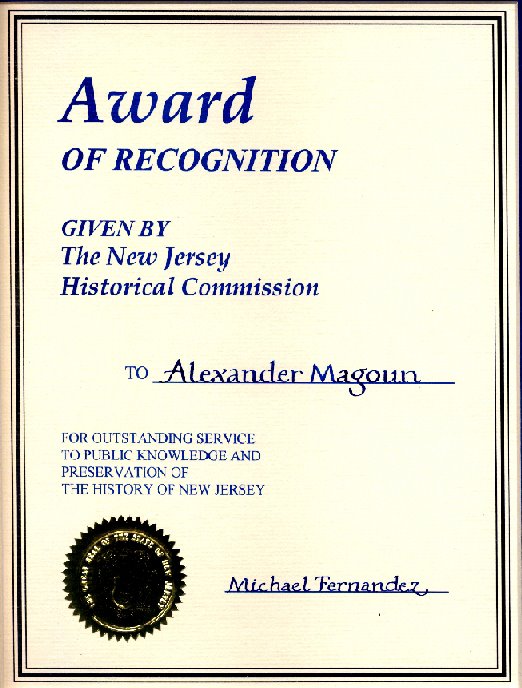
On Saturday, November 19, 2005, the New Jersey Historical Commission held its 28th annual awards ceremony in conjunction with its history conference at the Trenton War Memorial. Among the ten honorees on this occasion was Dr. Alexander B. Magoun, executive director of the David Sarnoff Library. One of four individual honorees, Alex received his Award of Recognition before 150 members of New Jersey's historical community, including Library board member Dr. Robert Bartolini.

The Commission's citation read as follows:

"Alexander Magoun, Princeton, is recognized for his sterling efforts to establish the library as a professionally run archive that documents innovation in science and engineering. It contains the largest collection of RCA materials in the state, documenting David Sarnoff's career and RCA's work in television, electron microscopy, transistors, computers, and video cameras. Mr. Magoun has rehoused this large collection in archivally appropriate containers and developed an array of services that draw on the rich materials within. These include response by email or phone to research inquiries, hosting researchers on subjects related to technology, the establishment of a popular website, the formation of partnerships with other organizations, public events and presentations--such as Hands-On Radio History and the Color Television Golden Anniversary Event, and tours for students and adults. Alexander Magoun holds a B.A. in history from Trinity College in Hartford, an M.A. from the University of East Anglia, and a Ph.D. in history from the University of Maryland."


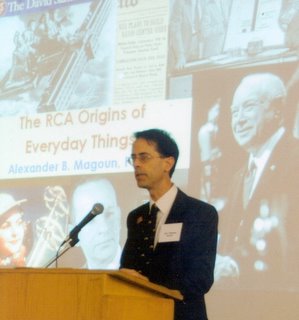
Alex in action, speaking on a favorite topic before 250 New Jerseyans at the Archives and History Day event at Monmouth County Library on October 15, 2005.

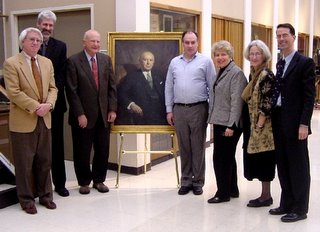
Alex with some of the members of the board of the Library after their meeting 0n November 28, 2005. From left to right: Dr. Robert Bartolini, Dr. Paul Israel, Arthur Sarnoff, Jeffrey Sarnoff, Rosita Sarnoff, Jinny Baeckler, and Alexander Magoun.

Looking Back at Fall Events II: Great Inventions


Attracted by the stories of Thomas Edison and RCA Labs as the founders of Route 1's high-tech corridor, over 100 people appeared Saturday, November 12, 2005, for an IEEE family affair on The Great Inventions in Central New Jersey at Sarnoff Corporation's auditorium and the adjoining David Sarnoff Library. They watched, listened, and asked questions as Jack Stanley, director of the Edison Museum at Menlo Park, described and demonstrated some of Thomas Edison's inventions; Dr. David Hochfelder toured the IEEE History Center's online museum and the wonderful store of documents online at the Edison Papers website; and Dr. Alex Magoun, executive director of the David Sarnoff Library, gave an illustrated lecture on "The RCA Origins of Everyday Things."

The Library thanks the Princeton-Central Jersey section of the Institute of Electronic and Electrical Engineers (IEEE). and in particular its chair, Iwan Santoso, for organizing the event--and providing the 30 pizzas for lunch!


Jack Stanley talks about Edison's aptitude for research as a boy.


Dr. David Hochfelder explains what a student can find in Thomas Edison's papers.

Looking Back at Fall Events I: War of the Worlds


Over 160 people of all ages turned out for the David Sarnoff Library's theatrical broadcasts of Howard Koch's and Orson Welles's War of the Worlds on October 29, 2005. Staged by the New Jersey Antique Radio Club and the Hunterdon Radio Theatre in Sarnoff Corporation's auditorium, the crowds at the two shows enjoyed the blend of art and science based on H. G. Wells's novella. Our thanks to Sarnoff Corporation, for providing the facilities; the Howard Koch Estate, for permission to use the original script; the NJARC and especially its members (Marv Beeferman, Joe Bentrovato, Sal Brisindi, Ray Chase, Joe Cro, Darren Hoffman, Harry Klancer, Al Klase, Dave Snellman, and Phil Vourtsis) for loaning, setting up, and operating the radio "station" and 16 receivers; the Hunterdon Radio Theatre and its cast of 20 for staging and performing the play; KMA Events, for marketing, graphic coordination, and decoration; suite6designs, for poster design; Robert Hummel, for the Lobby signage; Grover's Mill Coffee, for providing hot drinks at the Meet the Artists reception; Kip Rosser, for his period theremin music; the Board of Directors of the David Sarnoff Collection, the New Jersey Principals and Supervisors Association, and Panasonic Technologies for underwriting support; and the New Jersey Historical Commission, a division of the Department of State.

Photos below:

Thursday night, October 27: Sarnoff Corporation auditorium as the NJARC begins setting up.


Al Klase and Dave Snellman build the radio station.


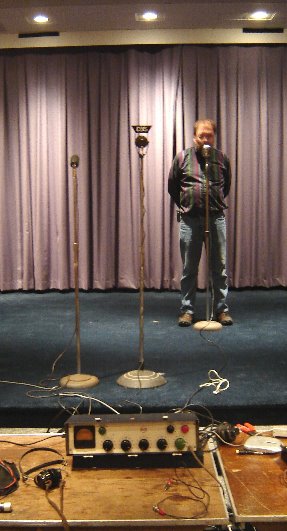
Al Klase tests
the period mics.

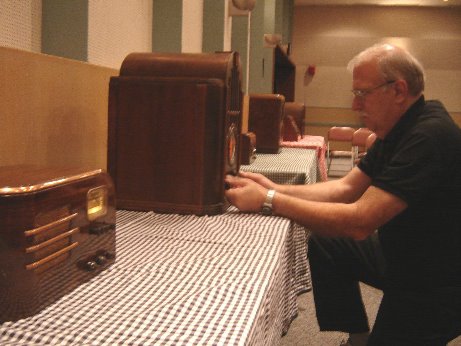
Phil Vourtsis tunes
the receivers.


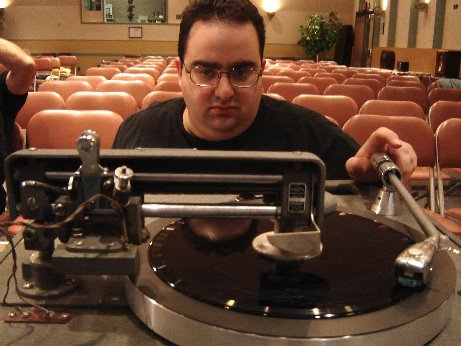
Darren Hoffman cues
an acetate recording disk.


The cast and crowd await the director.

And the show begins. . .

Tuesday, November 08, 2005

The Great Inventions of Central New Jersey

This Saturday, November 12, from noon to 2:30 in Sarnoff Corporation's Auditorium, the David Sarnoff Library will host "The Great Inventions in Central New Jersey" for the Princeton-Central Jersey section of the Institute of Electronic and Electrical Engineers (IEEE).

Jack Stanley, Director of the Edison Museum at Menlo Park will describe and demonstrate some of Thomas Edison's inventions, including the phonograph, created this first, and most significant, invention factory in what is now Edison, NJ.

Dr. Alex Magoun , Executive Director of the David Sarnoff Library, will give an illustrated lecture on "The RCA Origins of Everyday Things": color TV, video displays, video cameras, semiconductors, and computers. The David Sarnoff Library will also be open to tours showing many of the technologies seen and discussed on-screen.

Dr. David Hochfelder, Fellow of Livingston College at Rutgers University and Assistant Editor at the Thomas Alva Edison Papers, will lead a walk through the IEEE History Center's online museum and the wonderful store of documents online at the Edison Papers website.

Thanks to the sponsoring local chapter of the IEEE, there will be refreshments, but you should RSVP to pcjs.event@ieee.org to ensure there is food for all. The IEEE chapter already has received 75 reservations. Please put “RSVP INVENTIONS” in the subject.

Thursday, October 13, 2005

War of the Worlds Returns

FOR IMMEDIATE RELEASE
Contact: Alison Donald, (609) 688-0773

DAVID SARNOFF LIBRARY TO HOST LIVE
“WAR OF THE WORLDS” RE-ENACTMENT ON OCTOBER 29
Full-Scale Performance Will Mark the 67th Anniversary of Welles’s Radio Broadcast

PRINCETON, N.J., October 13, 2005—Reviving one of the most famous events in American radio, the David Sarnoff Library, in cooperation with the Hunterdon Radio Theatre and New Jersey Antique Radio Club, will host a live re-enactment of Orson Welles’s 67-year-old broadcast, “War of the Worlds,” based on H.G. Wells’s classic story. This family-friendly event, which will benefit the Library’s renovation, is scheduled for Saturday, October 29 in Sarnoff Corporation’s auditorium in Princeton, N.J.; a matinee and evening performance will occur, as well as a special benefit reception.

On October 30, 1938, Orson Welles and his Mercury Theater On the Air captivated the nation and set off widespread panic—especially in New Jersey and New York—with a dramatization of H.G. Wells’s late-19th Century fantasy. Thousands of listeners across the country mistook the broadcast for news reports of an actual Martian invasion that detailed meteor landings in nearby Grover’s Mill, N.J. and aliens killing earthlings with death-rays. What resulted was mass hysteria, with residents fleeing their homes or joining to combat the “Martians.”

“David Sarnoff predicted and innovated the power of network broadcasting,” says Alex Magoun, executive director of the David Sarnoff Library. “Welles’s broadcast showed how the media could instantly encourage national hysteria as well as national unity. We think that’s a powerful lesson worth repeating. Moreover, the Princeton Observatory and Grover’s Mill, where the Martian launches and landing were reported, are only a mile away from us.”

The “War of the Worlds” broadcast, which was written by Howard Koch and made famous by Welles is “arguably one of the best radio dramas of all time,” says William Spear, founder and president of the Hunterdon Radio Theatre. The group, which will stage the re-enactment with more than 20 actors, is “excited about the opportunity to work with the David Sarnoff Library and present its version of the broadcast.” The sound effects and actors’ voices will be transmitted through 1930s microphones to 1930s radios, provided by members of the New Jersey Antique Radio Club. An interactive discussion, led by Magoun, will follow the program.

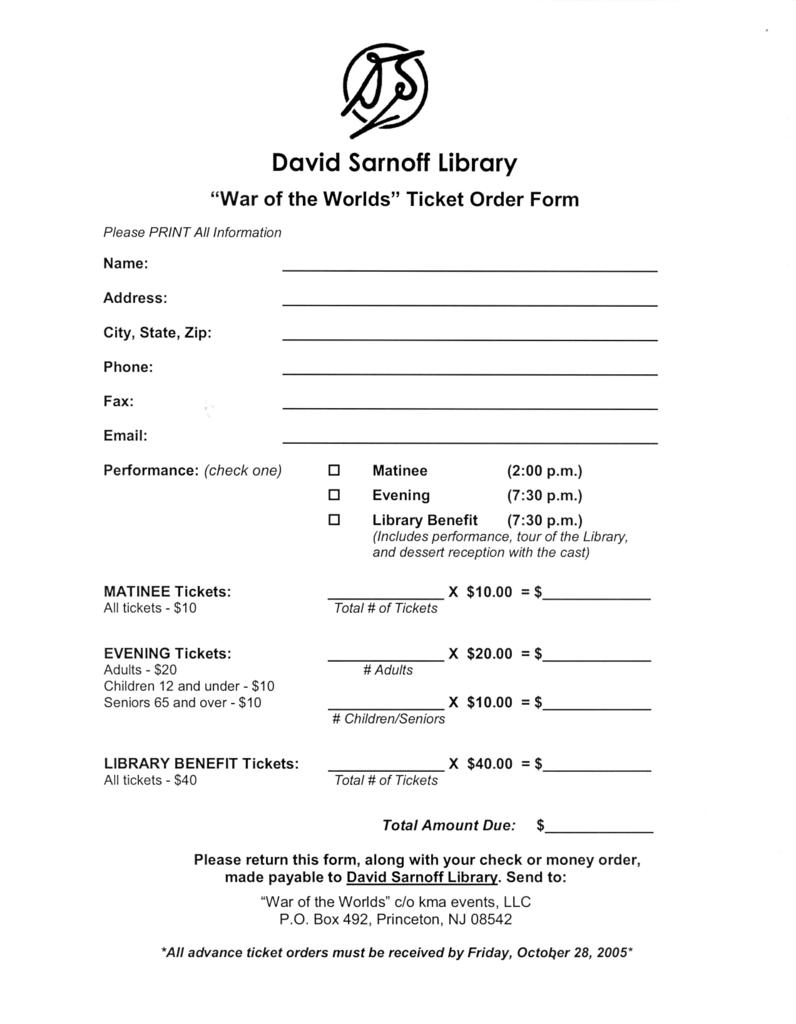
Performances will begin at 2:00 p.m. and 7:30 p.m., with doors opening one hour prior to the shows. All tickets for the matinee performance are $10 in advance ($15 at the door). Ticket prices for the evening performance are as follows: adults are $20 in advance ($25 at the door); children (12 and under) and seniors (65 and over) are $10 in advance ($15 at the door).

Library Benefit tickets are also available for $40 in advance ($50 at the door). Benefit guests will not only enjoy the evening performance, but also a tour of the Library and dessert reception after the broadcast to meet the cast. Live music will be provided throughout the reception by renowned thereminist, Kip Rosser. Tickets are limited and advance reservations are strongly recommended.

All funds raised from this event will support the David Sarnoff Library, a nonprofit organization housed within Sarnoff Corporation in Princeton. Incorporated as the David Sarnoff Collection, the Library contains an archives and museum with the state’s largest holdings of RCA historical materials, and is dedicated to the understanding and promotion of electronic innovation. Funds will specifically pay for the design of two new exhibits in the Library—David Sarnoff and the Innovative Spirit and Six Innovations that Changed the World. The Library is open by appointment to individuals and school groups. For more information, visit www.davidsarnoff.org on the Web.

The “War of the Worlds” re-enactment is made possible, in part, by in-kind support from Sarnoff Corporation; the Howard Koch Estate; Hunterdon Radio Theatre; New Jersey Antique Radio Club; Kip Rosser; and suite6design.

Additional assistance and funding has been provided by the Board of Directors of the David Sarnoff Collection; the New Jersey Principals and Supervisors Association; Panasonic Technologies, Inc.; and an operating support grant from the New Jersey Historical Commission, a division of the Department of State.


For more information about the event or advance ticket reservations, send an email to waroftheworlds@davidsarnoff.org, call (609) 688-0773, or copy and print the order form below (full-size is 8.5" by 11"): # # #

Friday, July 08, 2005

Library Open House Saturday July 16

David Sarnoff Library Open House
When: Saturday, July 16, 2005, 10 a.m. - 4 p.m.
Where: Sarnoff Corporation Lounge and Auditorium and the David Sarnoff Library
What: Radio repair clinic, lectures, old-time radio for children, exhibits on innovations that changed the world
Why: To promote and appreciate the innovative spirit
Cost: Free (not including parts), contributions welcome

Once again the David Sarnoff Library opens its doors and offers a variety of experiences that refire the innovative spirit in visitors. "Almost 100 years ago, David Sarnoff saw the future in electronic communications," says Executive Director Dr. Alex Magoun. "He and countless engineers, scientists, and staff at RCA and related companies have worked since then to make that future happen. We're pleased to show off some of their accomplishments and have visitors experience some of the cultural changes that resulted from their innovations."

Dr. Magoun will give an illustrated lecture on that theme, David Sarnoff and the Innovative Spirit, at 11 a.m. and 2 p.m. in the Auditorium. The basis for the coming redesign of the Library's exhibits, the lecture shows how Sarnoff expanded the possibilities for electronic media throughout his life and through the legacy of Princeton's David Sarnoff Research Center.

There were will be numerous other activities as well, including

1. Gary Wilson, Public Information Officer of the American Radio Relay League, will offer a display and offer visitors use of an amateur radio station. Amateur radio volunteers and their technology operate emergency communications in networks throughout the world wherever power lines have failed; they also use the technology for Morse and voice communications as a hobby that dates back to the beginning of Sarnoff's career one hundred years ago.

2. Visitors can compare radio culture for children in the 1920s and 1930s with the electronic entertainments that they enjoy today through computer games and DVDs, courtesy of Friends of the Library Jerry and Marsha Simkin. What did people listen to on the radio 50-70 years ago? Hear for yourself on a variety of working antiques...

3. Puzzling over the value, condition, or future of your old radio? The New Jersey Antique Radio Club offers a free clinic. Call (609) 734-2636 with the make and model to make an appointment on the hour for one-on-one attention. Many radios can be fixed in less than 60 minutes, and the New Jersey Antique Radio Club’s experts will do it for free! Parts are not included but are generally surprisingly inexpensive.

4. The museum will be open and include the following exhibits.

A. Sarnoff's career started with radio, which looked quite different from today's products. RCA's first radio from 1922 would have a hard time fitting on your bedside table, or in your car or pocket. The 1928 RCA-Victor home entertainment system that Sarnoff conceived of, combining record player and radio, probably wouldn't fit with the decor in your home either, and it doesn't play digital media.

B. Remember records? You can see an exhibit showing the iPod of its generation, RCA Victor's revolutionary record changer from 1949 and the seven colors that 45s first appeared in. The world’s first 45, invented in Camden, is on display while a working 45 Victrola and a Columbia cylinder Graphophone will play some of the sounds you want, when you want them.

C. Electronics became smaller with Bell Labs' invention of the transistor, and researchers in Princeton improved on it to make possible the smaller and versatile devices on which we rely today. See the world’s first transistor radio and the first solid-state video camera, designed and built at the David Sarnoff Research Center in the early 1950s. See yourself in living black and white through a 1951 TV camera on the 1948 RCA television--both built in Camden--that started America's video age.

D. RCA’s first color television, the CT100, is rarer than a Stradivarius violin but you can watch a variety of antique color videos during the day.

E. Why do televisions have to be so boxy? Former DSRC researcher George Heilmeier just won the Kyoto Prize for leading a team in the invention of the first liquid crystal displays (LCDs), based on a discovery by the DSRC's Richard Williams. The LCDs inspired researchers around the world to develop the flat panel screens we use in everything from cell phones to wall-size video. You can see the notebooks and early LCDs on display.

Call (609) 734-2636 for more information, and visit davidsarnoff.org for directions.

This event is made possible in part through a general operating support grant from the New Jersey Historical Commission, Department of State.

Thursday, June 02, 2005

Five Princeton Inventions That Changed the World

What: An Illustrated Lecture (free!)
When: Wednesday, June 15, 7:30 pm
Where: Sarnoff Corporation Auditorium, 201 Washington Road, Princeton
Who: Alex Magoun, Ph.D., executive director of the David Sarnoff Library
Why: The Library’s contribution to the CelebrateNJ! festival in June

Color television, transistors, computers, video cameras, liquid crystal displays (LCDs)—these technologies all shape how people live and communicate around the world. They also share a common origin, here at Princeton's RCA Laboratories. Guided by Alex Magoun, executive director of the David Sarnoff Library and author of the Arcadia Books photohistory of the Labs, take a tour of the stories of their invention and innovation, focusing on the human factors that shaped their development at one uniquely innovative company.

“Three generations of engineers and scientists have created a rich and unique history of world-changing innovation that runs right into the present,” says Magoun. "This talk skims the surface of a well of creativity matched only by Thomas Edison. It may also connect you with your neighbor, or your neighbor’s parents, or grandparents.”

“Five Princeton Inventions” offers a useful source of local history, and an introduction to issues that innovators confront today. A condensation of Dr. Magoun’s popular Princeton Adult School class last fall, this illustrated lecture offers the same mix of education with dashes of entertainment. Magoun explains the roles that inventive styles, funding sources, corporate priorities, inventors elsewhere, commercial rivalries, and government involvement all have on the process by which inventors, entrepreneurs, and consumers improve our lives.

Doors will open at 7 pm and visitors can see the inventions discussed in the David Sarnoff Library before and after the lecture. Refreshments will be served. Call (609) 734-2636 for more information, and visit davidsarnoff.org for directions.

This lecture is made possible in part through a general operating support grant from the New Jersey Historical Commission, Department of State.