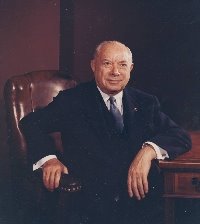
Presumably readers are aware the David Sarnoff Library closed its doors at Sarnoff Corporation in Princeton at the end of 2009. Naturally we were all unhappy with that decision, but thanks to the board of directors, volunteers, and project staff, we managed to find new and productive homes for the archival and artifact collections. The Hagley Library in Wilmington, Delaware, is presently engaged in archivally digesting 2,200 cubic feet of RCA lab notebooks, reports, photos, and other largely paper-based collections. The Camden County Historical Society received several late-1940s RCA Victor "home instruments" made in Camden. InfoAge's Marconi Hotel in Wall Township, NJ, received the RCA Broadcast Equipment manuals collection and a painting of David Sarnoff, which was appropriate since Sarnoff visited several times. And last but hardly least, The College of New Jersey received the museum collection for resurrection as a teaching museum. Given the state's budget crisis, it may be awhile before visitors can once again appreciate the remarkable stories and themes comprised in Sarnoff's life and RCA's arc. But we wish Dean John Laughton and new curator Emily Croll well in rising to this exciting and worthy challenge.
Showing posts with label David Sarnoff. Show all posts
Showing posts with label David Sarnoff. Show all posts
Friday, July 22, 2011


Tuesday, July 15, 2008
The Power of the Press
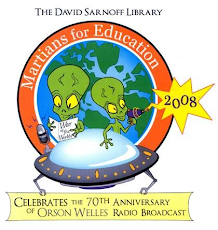
Yow! The Princeton Packet follows Town Topics' feature article last winter with a double feature today. First, an article by Adam Grybowski on Library executive director Alex Magoun, David Sarnoff, and RCA's inventions as exhibited in the museum, with multiple photos by Mark Czajkowski; and then an article on the Library's Martians for Education campaign and logo. Can the Today Show and Jon Stewart be far behind?
Friday, June 27, 2008
Now Playing on TV of Tomorrow
Hear executive director Alex Magoun speak on the history of television, interactive TV in historical perspective, David Sarnoff, and The Farnsworth Invention on Tracy Swedlow's TV of Tomorrow internet radio show! Tracy is the founder and editor of Interactive TV Today, which has covered the business of interactive television for ten years. She met Alex at the Early TV Foundation convention in Hilliard, Ohio, several years ago and followed up with this hour-long interview because of the publication of Alex's book, Television: The Life Story of a Technology, which discusses interactive TV and internet video in the final chapter.
Monday, May 12, 2008
Sarnoff's Emmy Returns
One of the highlights in our museum tours is explaining how the Emmy award honoring the best in television programming, technique, and technology got its name from the Image Orthicon  video camera tube invented at the new RCA Laboratories in Princeton during World War II. (See project head Albert Rose with his brainchild on the right.) We have the first "Emmy," or "immy" tube, as NBC's engineers nicknamed it but no Emmy, much to the dismay of volunteer Sharon Chapman. Thanks to her gentle prodding, executive director Alex Magoun arranged for the return of David Sarnoff's 1962 Trustees Award Emmy from its case in Sarnoff Corporation's lobby. It now enjoys a case of its own after a quick trip to the optical polishing shop, where Doug Coombs gave the gleaming statuette the once-over. Welcome back, general!


 video camera tube invented at the new RCA Laboratories in Princeton during World War II. (See project head Albert Rose with his brainchild on the right.) We have the first "Emmy," or "immy" tube, as NBC's engineers nicknamed it but no Emmy, much to the dismay of volunteer Sharon Chapman. Thanks to her gentle prodding, executive director Alex Magoun arranged for the return of David Sarnoff's 1962 Trustees Award Emmy from its case in Sarnoff Corporation's lobby. It now enjoys a case of its own after a quick trip to the optical polishing shop, where Doug Coombs gave the gleaming statuette the once-over. Welcome back, general!

Thursday, April 10, 2008
Martians for Education logo design contest
Martians who can send a fleet of spaceships to Earth and nearly destroy the world with heat beams and giant tripod vehicles surely had excellent training science and engineering. We don't have to match the Martians, but what David Sarnoff once said--"Our children today must be inspired to become the scientists of tomorrow"--remains a reality when we face once unimaginable economic, environmental, energy, and security challenges. To follow up on our successful January field trips we need funds to develop and conduct programs for other grades.
So, to encourage more interest in science and technology to solve today’s global challenges, the David Sarnoff Library is holding a contest for design of the logo marking its events during the 70th anniversary of Orson Welles’ radio broadcast of War of the Worlds. These events on Friday-Saturday, October 24-25, will help raise funds for the Library’s educational programs, culminating in the Saturday night recreation of the broadcast in Sarnoff Corporation’s Auditorium next to the Library at 201 Washington Road, Princeton.
The logo should incorporate graphics representing the following items:
· Martian(s)
· Education
· 70th Anniversary or 1938-2008
· Grover’s Mill, New Jersey
· David Sarnoff Library
The rest is up to you! The most original, professional, and informative design will be chosen as the David Sarnoff Library’s official Martians for Education 2008 logo.
The deadline for entries is June 2. The winning logo will be unveiled at the Library’s annual meeting in June (date tba). Entries may be submitted to davidsarnofflibrary@gmail.com or to
Martians for Education Logo Design Contest David Sarnoff Library
201 Washington Road
Princeton, NJ 08540-6449
Remember to include the following information with your entry – your name, age, address, telephone number, and e-mail address. Digital designs must be at least 300dpi tiff or hi-res jpg.
All entries become the property of the David Sarnoff Library, and will not be returned once they are submitted. The winning logo will appear on promotional material and merchandise for the Library. Entrants who are under the age of 18 need a parent or guardian to certify that they are entering this contest with permission. Individuals may submit multiple entries. Judging of this contest is based solely on the discretion of the Library’s judging panel. Prizes will be awarded to the top three designs.
So get out your thinking caps and start designing. The Martians are coming, and we need a logo that will tell the world!
Thursday, March 06, 2008
Farewell to The Farnsworth Invention?
Aaron Sorkin's Broadway play The Farnsworth Invention closed last weekend after a three-month run at the The Music Box Theatre. According to Variety, its box office suffered from the strike last fall that began on opening night, and competition from a number of other non-musical productions. Thanks to the gift of Library friend George Cody, I had the opportunity to see it before it closed, and offer these thoughts as a reflection on the power of fact and fiction to make us think about the people and ideals behind our material world.
Having spoken with Sorkin's assistant at length, provided David Sarnoff actor Hank Azaria with a bibliography, read the script, and read and heard a great many reviews, I took my seat with some trepidation. Yet there on the scrim concealing the stage were projections of Philo Farnsworth's patent and notes for his image dissector. How odd is that for a theatre district that lives on musical spectaculars? When the play opens, there's the smartly dressed Sarnoff as characterized by Sorkin and Azaria--direct, aggressive, idealistic--introducing the subject, the invention of television, and the protagonist, Farnsworth, as a schoolboy in rural Idaho.
And off we go, from an untutored genius in a remote one-room schoolhouse to Sarnoff's escape from Russian pogroms to his perceptive understanding of the power of radio broadcasting and the rise of RCA in the 1920s. While Farnsworth pluckily cobbles together a team of family members to help him demonstrate the first public electronic TV transmission (Vladimir Zworykin made an internal demo of his electronic system in 1925), Sarnoff engineers RCA's growth into a multimedia empire, only to see it collapse in the speculative Crash of '29. This certainly resonated with an audience all too aware of reverberations of the bursting subprime bubble.
My concerns turned to from relief to pleasure and then joy as I watched the cast recreate the spirit of creativity, wonder, competition, and disillusionment in high technology. Sorkin, director Des McAnuff, and the rest of the ensemble created an alternate universe in which they realized a Sarnoff different in shape and manner from the one that I and the Sarnoff family and older RCA staff know. But not in his essence: there they’ve caught and manifested David’s understanding of the power and possibility of communications, a conviction he maintained from the questionable quality of radio programs to the televised riots and warfare of the 1960s—because he knew we have no choice. Some may feel that the final scene doesn't fit: a bar whose patrons are riveted by the televised moon landing (how the camera beat the lander to the surface requires some suspension of disbelief). But it caps the story with the ideal use that Sarnoff and Farnsworth hoped for "their" invention: the sight of the moon's vast wasteland justifies the landscape broadcast by the commercial networks.
The flaws with the play are not in Sorkin's mash-up of history and fiction, or the amount of information he pours out through his narrators and characters. They appear in the effort to make a tragedy out of a conflict between an inventor and an innovator. There are lots of brilliant inventors, but many of their inventions or patents never make it to the factory or the consumer, because of technical drawbacks, someone's else better idea, the lack of entrepreneurial support, the wrong market, or the wrong cultural moment for the right market. There are arguably fewer brilliant entrepreneurs, who have a vision, a place for particular inventions and products within that vision, and a sense of what the right market will bear. And here, that innovator is a force of nature few of us can comprehend, because he is not only single-minded but also correct about the future of communications, again and again and again. Sarnoff invariably "wins" because as innovator he commands the financial and intellectual resources to take the best inventions and organize the groups necessary to turn them from paper ideas into a popular commercial product.
So is that a tragedy, and what do we make of the title? Jimmi Simpson, who played Farnsworth, was equal to the challenge of maintaining his character's near-manic drive, his optimism, and his disillusionment when he understands the inherent flaw in the camera he invented. He held his own in his encounters with Azaria's Sarnoff; more than that we see how untutored, and consequently unfocused, this genius was. It's hard to imagine a better case for nurturing the brilliant young people in our cities and our countryside than seeing young Philo trying to explain his image dissector to his ninth-grade teacher, sell his idea to a couple of traveling salesmen with some savings, and fix the unfixable in his clever but flawed TV camera.
None of this has much to do with Sarnoff, but an audience unconsciously expecting the tragic bioplay of a lone inventor finds him matched if not overshadowed by the corporate visionary and innovator. Azaria did his job all too well in filling Sarnoff's shoes. He was ambitious and commanding in the service of a noble cause, and he was also human, with a wife who knows how to take him down a peg when necessary. Without a David Sarnoff we can identify with as well as wonder at, there is no dramatic tension, no story in which an audience may ponder the wonder of our inventiveness, the ambitions and unfairness of life, the meaning of our achievements.
It's not called the The Sarnoff Innovation but it might as well be, given the RCA leader’s taking on the government and the rest of the broadcast and electronics industries to bring electronic TV to the American household, for better and worse. That story may never have the dramatic tension that Sorkin creates, at least not until Peter Sellars writes the opera. Until then Sorkin leaves us wondering whether TV is Farnsworth's invention after all.
Monday, February 25, 2008
Reader's Choice: Television: The Life Story of a Technology
We've heard from several readers how much they enjoyed the history, explanations, and style of executive director Alex Magoun's new book for Greenwood on the history of television from the discovery of a photoelectric effect in selenium in 1873 to the Consumer Electronics Show in 2007. But now Choice: Current Reviews for Academic Libraries ("the premier source for reviews of academic books, electronic media, and Internet resources of interest to those in higher education"), has given it two thumbs up in this review from its February issue:
Tracing the history of television from early inception through golden age, to the current world of flat screens, cable, and satellites, Magoun (David Sarnoff Library) comprehensively overviews a medium now in everyone's memory. He readily admits that he neither watches television nor possesses any technical training in chemistry or physics, but these have not hampered his research skills. Magoun provides an interesting historical survey of major inventors, companies, and influences in the life story of a technology known as television. He writes from the perspective of a witness to the conception and birth of television. He continues to document its life from the role of a parent who ultimately must witness the eventual breaking away of the "child" so that it could forge ahead to build the revolutionary digital world, and he follows its eventual death as medium of choice for most people. Along the way, Magoun reveals how society has also evolved with each change in technology. Readers are left with an appreciation for an old friend that they enjoyed having around, as well as recognition of the role that television has played in making entertainment and communication what it is today.
Tracing the history of television from early inception through golden age, to the current world of
 flat screens, cable, and satellites, Magoun (David Sarnoff Library) comprehensively overviews a medium now in everyone's memory. He readily admits that he neither watches television nor possesses any technical training in chemistry or physics, but these have not hampered his research skills. Magoun provides an interesting historical survey of major inventors, companies, and influences in the life story of a technology known as television. He writes from the perspective of a witness to the conception and birth of television. He continues to document its life from the role of a parent who ultimately must witness the eventual breaking away of the "child" so that it could forge ahead to build the revolutionary digital world, and he follows its eventual death as medium of choice for most people. Along the way, Magoun reveals how society has also evolved with each change in technology. Readers are left with an appreciation for an old friend that they enjoyed having around, as well as recognition of the role that television has played in making entertainment and communication what it is today.
Summing Up: Highly recommended.
General readers; lower- and upper-division undergraduates.
-- C. S. McCoy, University of South Florida
-- C. S. McCoy, University of South Florida
(Reprinted with permission from CHOICE, copyright by the American Library Association.)
Monday, January 21, 2008
Looking back while Looking Ahead
We've just concluded an amazing week: four days of field trips for 200 third graders, and another jam-packed open house on Saturday. If the engagement of the children from Dutch Neck Elementary School is any indication, the American prospect is brighter than we think. They took in Alex Magoun's illustrated talk on David Sarnoff's immigrant experience, they collected data in a wide-ranging scavenger hunt in the museum under Sharon Chapman and Vrinda Kaimal's guidance, and they mastered the concepts of sound waves, propagation, and reproduction in some cool interactive programs run by Alex and musician Samantha Chapman. Several of them returned Saturday, parents literally in tow, to see and hear thereminist Kip Rosser and the electronic musicians of Brainstatik.
We'd like to thank all of the above, plus those who helped behind the scenes: Jeff Grabel for organizing this enlarged sequel to last spring's pilot trip; Dutch Neck principal Scott Feder; Carolann Churins, Sarnoff Corporation vice president for adminstration; educational consultant Jane Eilbacher; Forrest Bradbury of Princeton University, and Mike Bunting, Mike Kane, Dennis McClary, and Fred Vannozzi of Sarnoff Corporation for more technical support than you can imagine.
We'd like to thank all of the above, plus those who helped behind the scenes: Jeff Grabel for organizing this enlarged sequel to last spring's pilot trip; Dutch Neck principal Scott Feder; Carolann Churins, Sarnoff Corporation vice president for adminstration; educational consultant Jane Eilbacher; Forrest Bradbury of Princeton University, and Mike Bunting, Mike Kane, Dennis McClary, and Fred Vannozzi of Sarnoff Corporation for more technical support than you can imagine.
Tuesday, January 15, 2008
Remember The Open House on Saturday!
As posted below, on Saturday, January 19th between 10:00 am and 4:00 pm we will be hosting an Open House at the David Sarnoff Library. Dr. Alexander Magoun will be offering guided tours of the library's exhibits at 10:00, 11:00, 1:00, 2:00 and 3:00; thereminist Kip Rosser and Brainstatik will be providing musical entertainment; and the New Jersey Antique Radio Club will host a radio repair clinic.
Admission to the open house is free, although donations to support the library are always gladly accepted. Directions to the library can be found here.
We hope to see many Friends of the Library on Saturday, as well as some of the charming Dutch Neck Elementary School third graders who have been visiting the library this week on field trips. And, of course, we always hope to welcome first-time guests and other returning visitors who want to see just what all of the fuss is about.
Saturday, January 05, 2008
Radio Merit Badge Day at the David Sarnoff Library
We just qualified 55 Boy Scouts from all over the Central New Jersey Council for their radio merit badges today! The David Sarnoff Library, with the generous support of Sarnoff Corporation, hosts this wonderful event on the first Saturday of every January because it can provide the space for the Boy Scout leaders and their amateur radio volunteers to set up four work stations and four radio stations, as well as two or even three classrooms for the scouts to work through the requirements of the radio merit badge. In four years, over 250 scouts have qualified, and many of them have pursued their amateur radio operator's licenses as well.

 Then the scouts and their parents have to appear and sign in, and when they've gathered in the auditorium, organizer Gary Wilson, K2GW, welcomes them and explains the day's schedule.
 The Library's executive director, Alex Magoun, introduces the crowd to David Sarnoff's amazing career in radio, starting as an office boy and wireless operator and ending as a seer of our internetworked wireless world in the 21st century.

First the staff had to set up their posts, like this one on the Library patio, bright and early in the morning.
 Then the scouts and their parents have to appear and sign in, and when they've gathered in the auditorium, organizer Gary Wilson, K2GW, welcomes them and explains the day's schedule.
 The Library's executive director, Alex Magoun, introduces the crowd to David Sarnoff's amazing career in radio, starting as an office boy and wireless operator and ending as a seer of our internetworked wireless world in the 21st century.
With that story fresh in their minds, the scouts make their appointed rounds: to the Lounge, the patio,
 the office suite,
 and the museum,
 among others.
the patio, the office suite, and the museum, among others.At the end of the day, the scouts gathered again in the Auditorium to receive their certificates (the badges are in the mail). But they received far more than they bargained for, because Princeton University's Dr. Joe Taylor, K1JT and Nobel Laureate, dropped by to explain how his radio hobby and experiments as a child got him started on a wonderfully fulfilling career in physics and radio astronomy, in which he and fellow Nobel Laureate Dr. Russell Hulse discovered the first binary pulsar.  O, the places you can go in wireless!
Wednesday, January 02, 2008
Library Open House and Repair Clinic
Happy 2008, everyone, as the David Sarnoff Library prepares for an even bigger and better year of education on innovation, based on RCA's amazing legacy! Save the date of Saturday, January 19, from 10 am to 4 pm, as the Library opens its doors once again to a variety of wonderful indoor activities.
Have you seen or heard about Aaron Sorkin's Broadway hit, The Farnsworth Invention, and want to know more? RCA and television historian Dr. Alex Magoun will offer guided tours of the Library's exhibits on the hour at 10 and 11 am and 1, 2, and 3 pm. See and hear the incredible stories behind David Sarnoff's amazing life, and the remarkable inventors at RCA who brought you everything from microchip computers to color TV!
This year we're bringing back electronic music through the kind services of Kip Rosser, master thereminist, and Brainstatik, one of the groups who blew audiences away at our Electromusic Chamber Concert last December! Kip engages and enthralls young and old with the amazing electronic instrument that plays music through handwaving. Kip's Theremin Feast in the David Sarnoff Dining Room will offer menus with everything from appetizers (the history of the theremin divided up into story tidbits) to Classical Entrees (classical music) to Romantic Suppers for Two (jazz songs with a romance theme) to a Beatles Buffet(self-explanatory) and more. There will be a total of about 50 songs and pieces on the menu. Kip will explain and play the theremin in the David Sarnoff Dining Room between 10 am and 1 pm, offering visitors a chance to play for themselves.
Meanwhile, in the afternoon, Brainstatik's musicians and technicians use a variety of synthesizers to replicate and embellish the sounds made by keyboard, reed, string, and percussion instruments, all to a shifting and synchronized background of light and video. while Brainstatik with take the auditorium stage from 2 to 4 pm. What better way to unwind after a hard week or day?
Finally, if you've an old, or old, old radio, make an appointment for the New Jersey Antique Radio Club's repair clinic. If its experts can't fix it for you in an hour, they can surely tell all about where and when it was made--for free! Contact Phil Vourtsis at pvourtsis@optonline.net to make an appointment; be ready to have the make and model number of your tabletop or console treasure.
The Library doesn't charge admission but suggests a $5 donation per person if you enjoyed your visit.
Need directions? Use 201 Washington Road, 08540 on your favorite internet map and follow the signs at Sarnoff Corporation's entrance to the non-profit Library.
Monday, December 03, 2007
David Sarnoff, Vladimir Zworykin, and The Farnsworth Invention
Tonight, Aaron Sorkin's play finally hit the Broadway stage, and we expect the reviews will be as glowing as the buzz from the many people who saw the previews. Hank Azaria won over even those adamantly opposed to the scripted depiction of David Sarnoff through impeccable preparation and his ability to capture and play off of Sarnoff's vision of a better world united by electronic communications systems.
That said, it is well worth noting, as Paul Schatzkin has written at length in trying to redeem Phil Farnsworth's role in the invention of television, that Sorkin's play is a fiction. He writes in the broadest parody of history. He names characters after historical figures, places them in relationships vaguely relevant to their known character and behaviors, and abandons technical, legal, or commercial details for a fast-paced and engaging story in which no one comes off an innocent or a criminal.
That said, it is well worth noting, as Paul Schatzkin has written at length in trying to redeem Phil Farnsworth's role in the invention of television, that Sorkin's play is a fiction. He writes in the broadest parody of history. He names characters after historical figures, places them in relationships vaguely relevant to their known character and behaviors, and abandons technical, legal, or commercial details for a fast-paced and engaging story in which no one comes off an innocent or a criminal.
Still, the audience leaves thinking that Vladimir Zworykin, director of electronics research at RCA from 1930-54, stole a patented idea from Farnsworth in order to make his television camera work during a visit to the younger man's San Francisco laboratory in April 1930. Is this true? No. What did Zworykin, and his patron Sarnoff, do that has resulted in them getting such bad press for the last 20 years?
They did what Thomas Edison did with electric light: take an invented, impractical technology and--with a great deal of support from engineers, scientists, technicians, marketers, investors, and customers--turn it into a commercial system that we and the rest of the world have used ever since. Alexander Magoun has written the best synthesis of the how television was innovated in the 1920s and 1930s in the relevant sections of Television: The Life Story of a Teachnology (2007). Based on available scholarship, you can ask for it at your library, borrow it through inter-library loan, or read the briefer history of relevant events below.

 How good was the image dissector? Consider these photos from Donald Godfrey's solid if flawed biography, Philo T. Farnsworth: The Inventor of Television (2001). In the first, showing a photo and a screenshot around 1929, Pem Farnsworth closes her eyes against the light needed to capture her image, possibly outdoors. In the second, Farnsworth stages some football dummies on Philadelphia's Benjamin Franklin Parkway during his 1934 demonstrations. It appears to be overcast, so note the two stage lights set up to illuminate the target for the camera.


Patented and published proposals for television had existed since the 1880s, and an electronic solution, using no moving parts, since Alan Archibald Campbell Swinton posed the concept in 1908. Zworykin began work on electronic TV with his Russian supervisor Boris Rosing soon after, before World War I and the Russian Revolution interrupted his studies. In 1921, after Swinton elaborated on the challenge of making a camera that converted photons of light from an object into a succession of electronic images, Zworykin wrote a fellow émigré, Joseph Tykociner, about his ideas for a TV camera.
He convinced his boss at Westinghouse to invest in the project in 1923, when Zworykin applied for his first TV patent. Zworykin's initial "iconoscope," built and demonstrated in the corporate lab in East Pittsburgh, worked but poorly during a demonstration in 1925 to executives. During the process he and other inventors filed new patents on electronic imagers; Zworykin's 1925 application explained the concept of insulating the imager "pixels" for storage. To get an acceptable picture, the camera needs to store the light from an image, as electrons, between scans, to increase the dynamic range of the image's brightness. After he moved to RCA in April 1930, Zworykin spent three years recruiting skilled engineers, scientists, and technicians to overcome the bottleneck to practical, commercial, electronic TV: a camera that stored light electronically rather than requiring immense amounts of light to operate in a studio or outdoors.
Phil Farnsworth, as he preferred to be called, was the first to publicly demonstrate an electronic TV system, in 1928; unlike Westinghouse he needed the media attention to attract investors. He also won priority on a basic patent that he could not reduce to commercial practice for physical reasons that remain true today. The failed struggle against the laws of physics represents a pattern in all three of the inventions that his fans promote, and it's indicative of the real tragedy of Farnsworth's genius. What might he have done with university training, the mentorship or guidance that might have led in legitimately memorable directions?
We'll never know. The image dissector, the camera imager in which he received priority on the concept of an electrical image, had no storage capacity for the photo-electrons landing on its imager between scans. That is, it converted into electrons only the photons emitted from an object at the moment of scanning, which occurred 30 times a second. Since those 30 moments represent an infinitesimal fraction of a second, very little light information is captured for transmission. As a result the image dissector requires extremely high light levels, from bright sunlight or carbon arc lamps (used in movie projectors), to give a good picture. It was used only briefly in broadcasting movies and in certain industrial environments. For live action its primary advantage over the electromechanical systems that John Logie Baird and Charles Jenkins pioneered in the mid-1920s was the prospect of a larger if equally dim picture.
Zworykin was one of a series of corporate visitors to Farnsworth's lab, for the latter's backers were increasingly desperate as the Depression deepened to retrieve some of their investment. He spent three days in friendly and diplomatic engagement with the younger inventor and his amateur staff, and sent instructions on how to make a better image dissector back east for use until his team could reduce the iconoscope to practice. Shortly after returning himself, Zworykin filed another patent application specifying the storage principle in his imager.

 How good was the image dissector? Consider these photos from Donald Godfrey's solid if flawed biography, Philo T. Farnsworth: The Inventor of Television (2001). In the first, showing a photo and a screenshot around 1929, Pem Farnsworth closes her eyes against the light needed to capture her image, possibly outdoors. In the second, Farnsworth stages some football dummies on Philadelphia's Benjamin Franklin Parkway during his 1934 demonstrations. It appears to be overcast, so note the two stage lights set up to illuminate the target for the camera.
The fact that Farnsworth had a valid and well-written patent on the next big thing, however, forced Sarnoff and RCA to look further into his work. In the spring of 1931, Sarnoff visited the lab during a trip to California on sound-on-film business. As luck would have it, Farnsworth was closing a research deal with RCA's leading radio set rival, Philco, in Philadelphia because his San Francisco investors had abandoned him. In his absence, Sarnoff offered $100,000 for his patents as an opening bid in what should have been a negotiated settlement. But Farnsworth relayed a flat rejection to bring his family to north Philadelphia, where his boss Albert Murray was an ex-RCA manager who had previously given the image dissector a negative evaluation.
Late in 1932, one of Zworykin's team, Sanford Essig, overbaked an image plate and realized serendipitously that the mosaicked pattern of silver globules gave the world's researchers (besides Farnsworth) what they were looking for: a technique for insulating the image sensor's "pixels." Six months later, Zworykin began publishing the article on the iconoscope in five countries; within two years it had become the standard camera imager and with further improvements the U.S. and German militaries used it successfully in TV-guided missiles during World War II as well as in studio and outdoor cameras.


How good was the iconoscope? Here are two photos of Zworykin in the Camden lab and on-screen from around 1932-33, from the Leslie Flory Collection at the David Sarnoff Library, in an early internal demonstration of its sensitivity.
Meanwhile, Farnsworth attempted to work around the lack of storage and prior work by adding an electron multiplier to the image dissector. To avoid others' patents and disclosures, his "multipactor" differed from the multipliers developed by German researchers and improved by Zworykin and his team. Theirs kicked off additional electrons from a pinwheel or cascade design that triggered more electrons in proportion to those generated by the initial signal. The sequence could be repeated as desired to amplify the signal without stressing each of the successive paddles or plates. Farnsworth's multipactor simply bounced the growing number of electrons between only two plates with the result that it burned out very quickly and was never commercialized.
The problem for RCA was not in its approach to a TV camera, but in the priority of patents. Remember that patent systems are designed to assign a single inventor as a commercial incentive to invention. Patent conflicts obscure the fact that multiple people operating within the same domain of knowledge--like previous patents, publications, and usually educational programs--conceive regularly and independently similar solutions to problems. Thus Farnsworth and Max Dieckmann in Germany conceived of the dead end of the image dissector; Zworykin and at least four other inventors thought of ways to store electronic images for television.
Farnsworth's patent involving the concept of an electrical image in a TV camera issued in 1930 after Zworykin's visit. Two years later the Patent Office put it in "interference" with Zworykin's 1923 application. Naturally RCA defended its claims, and the court battle took four years to settle. Farnsworth won, largely on the basis of his public demonstration, and it remains unknown why Westinghouse wasn't more helpful in documenting Zworykin's work, which is now preserved on microfilm at the Historical Society of Western Pennsylvania. RCA had to license Farnsworth's patent and did so in 1939. Farnsworth and his company needed RCA's support since it had Zworykin's camera and the market power to innovate the commercial system. As a result, Farnsworth joined the enemy; he became part of the patent pool, exchanging his set of inventions for a million dollars and access to some 3,000 RCA patents.
The money offset ten years of Farnsworth's expenses while representing ten percent of RCA's investment in creating, testing, and making a complete system. Between 1939 and 1941, the two rivals became allies. Farnsworth recovered from one of his alcoholic periods to file for several more patents. Led by Sarnoff, RCA and Farnsworth's new company fought the rest of the radio and broadcast industries--Philco, Zenith, CBS, DuMont, etc.--and the Federal Communications Commission for approval of a commercial television standard. Sarnoff described Farnsworth in 1940 to a congressional committee as the man who had done more for television than anyone else outside RCA. In theory a standard would allow Farnsworth to make some money on the cameras using Zworykin's iconoscope, although the royalties on, say, the first five years of camera sales were hardly likely to cover current expenses.
The FCC's delay, consumer resistance to the available programming, and World War II all meant that commercial innovation would have to wait. Farnsworth's basic patents expired in 1947, when RCA was still two years from netting the first profits on its $50 million investment. Meanwhile ITT bought Farnsworth's struggling company and retained him as a vice president in research, allowing him to work on what he liked while enjoying stock options and a handsome salary.
Farnsworth's third memorable invention was electrostatic containment of nuclear fusion for the home heating and power. This proved even more impractical than the first two; there is a possibility that the technique could be made to work with a hydrogen isotope found in abundance on the dark side of the moon. Whether or not Farnsworth knew that, he spent a lot of ITT's money and then all of his own savings tilting at his final windmill in the 1960s. That, not RCA's patent strategy or the FCC's caution in setting a television standard, is why his family had nothing to show financially for a brilliant but mentor-less career.
RCA's staff moved beyond Zworykin's inventions to create better TV cameras during and after World War II. The image orthicon and the vidicon drew on Farnsworth's patent for low-velocity electron-beam scanning, along with numerous other RCA-invented techniques, materials, and components, to become the namesake for the Emmy award and video imagers used throughout the world and space into the 1980s. These tubes also used the storage principle, electron multipliers, and thin-film techniques for the image target that also helped Paul Weimer go on to make the first thin-film transistors (TFTs).
In sum, go to The Farnsworth Invention for the snappy dialog, the great acting, the comedy within the wrong tragedy. Respect the inventor Farnsworth for demonstrating an electronic TV signal at the age of 21, and pity him for the lost opportunities educationally and professionally, had he chosen to work in RCA's labs in the 1930s instead of ITT's in the 1950s. Admire the scientist, Zworykin, for recognizing his own limitations and assembling the team of technologists necessary to make television work as a system. And remain in awe of Sarnoff, the innovator, in whose absence from the historical record one wonders who would have led the free-market United States into the video age.
Subscribe to:
Posts (Atom)