Saturday, August 30, 2008
War of the Worlds YouTube Video
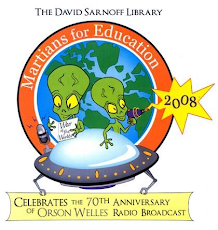
To kick off the celebration of the 70th anniversary of the historic War of the Worlds radio broadcast, which will be held at the David Sarnoff Library on October 25th, we've put together a little YouTube teaser advertisement. Noted thereminist Kip Rosser composed and performed the original music, WellsWelles Etude, for Seven Theremins; logo design winner Monica Vagnozzi's artwork is featured at the end of the video; and volunteer Sharon Chapman is responsible for the photographs and for putting the project together. Enjoy the video, and feel free to post it on your websites and share it with your friends.
Keep watching this blog for announcements about the October 25th celebration as the events are finalized and announced.


Tuesday, August 26, 2008
Crossroads of History, RCA/Victor style
How often do you expect to get a question about pre-1940 Korean phonograph records? If you answer the Inbox at the David Sarnoff Library, you could on it happening once in a lifetime because of Victor Talking Machine Company and RCA Victor's international operations. But this month, to our surprise, two scholars made inquiries, with an Argentinian graduate student inserting her request about the Victor 1920s offshoot, the Pan American Recording Company, in-between. Not everyone got what they hoped for, but the Library's executive director, Alex Magoun, demonstrated an intangible and invaluable value to the scholars but suggesting alternative sources and linking together people with shared interests.
"BMG, which bought RCA Records from General Electric Company in 1987, has records of recording dates at its archives in New York City. But corporate archives do not exist for outside researchers, and it is difficult to get access to BMG's Victor data.
"The best source that I know of is Eldridge Johnson's papers. Johnson started and ran Victor until 1927. His papers are located at the American Heritage Center in Wyoming, with photocopies at the Johnson Victrola Museum in Dover, Delaware. His correspondents included the head of the recording division and possibly Mr. Staats. Unfortunately, the AHC does not list the collection in its online catalog, and the Victrola Museum is not easily used by archival researchers, especially at a distance.
"Another source of information would be the 78-L List. The variety of collectors there may be able to help you with specific questions.
"Victor published a magazine, Voice of the Victor, for its dealers for about 25 years. There is a Spanish-language version for Latin America from 1915-31. A dealer in Uruguay sold several copies on Ebay several years ago. The Camden County Historical Society in Camden, NJ, has a large set of the English-language edition, and the Glendale Public Library in California has a large but incomplete collection as well.
"Some other writers on the music side of the record business are Ruth Glasser (My Music is my Flag: Puerto Rican Musicians and Their New York Communities, 1917-1940; U. of California Press, 2000) and David Suisman (The Sound of Money: Music, Machines, and Markets, 1890-1925, Columbia University dissertation, 2002), and William Howland Kenney (Recorded Music in American Life: The Phonograph and Popular Memory, 1890-1945; Oxford U. P., 1999). Their bibliographies may offer you some other avenues for research."
First up was Yamauchi "Yanchy" Fumitaka of University of Tokyo's Institute of  Oriental Culture. A cultural anthropologist by training, Yanchy is studying the relationships created between Japan and Korea by sound recording early in the 20th century, when Japan dominated Korea's audio entertainment industry. After completing a semester at Yale University through the Todai-Yale Initiative, he arranged a visit to the Library to draw on its runs of RCA publications for information on the company's international connections in the 1920s and early 1930s.
Oriental Culture. A cultural anthropologist by training, Yanchy is studying the relationships created between Japan and Korea by sound recording early in the 20th century, when Japan dominated Korea's audio entertainment industry. After completing a semester at Yale University through the Todai-Yale Initiative, he arranged a visit to the Library to draw on its runs of RCA publications for information on the company's international connections in the 1920s and early 1930s.Three weeks later, after Yanchy had returned to the humidity of Tokyo in August, Mi-Hye Chyun of Rider University's Westminster Choir College emailed the Library about several Korean records made by the Victor Talking Machine Company between 1908 and 1910. The Library doesn't have a set of Victor's catalogs, but Alex put her in touch with Yanchy and connected her to the University of California, Santa Barbara's Encyclopedic Discography of Victor Recordings. The discographers note on their site that their knowledge of East Asian Victor recordings is especially weak, so perhaps these connections will help improve it.
Just as Yanchy was sitting down to begin paging through the RCA News, in came an email from Marina Cañardo of the University of Buenos Aires (Universidad de Buenos Aires). Marina is a doctoral student in musicology and is researching "the relationship between Argentine popular music and the recording industry in the 1920s." Alex wrote her what he knew about sources in the United States and connected her to Yanchy and his professional colleague, Professor Susan Schmidt-Horning of St. John's University. Professor Schmidt-Horning is finishing her book, Chasing Sound: Recording Studios in America, almost as this is written, and looks forward to meeting her new colleagues at a suitable SHOT or ICOHTEC or other scholarly meeting.
Would you like to know what the Library and other organizations offer in the field of recording history? Here's what Alex wrote Marina:
". . . we have posted the significant Victor documents owned by the Library on the website: the two Sooy memoirs (based on their journals) and the history of Victor by B(enjamin). L. Aldridge.
. . . Unfortunately, the David Sarnoff Library has no information on the corporate operation of the Victor company or its domestic or international recording groups. Mr. Sarnoff kept virtually no records of his management of RCA, and we have yet to receive any collections of papers related to Victor's record business.
. . . Unfortunately, the David Sarnoff Library has no information on the corporate operation of the Victor company or its domestic or international recording groups. Mr. Sarnoff kept virtually no records of his management of RCA, and we have yet to receive any collections of papers related to Victor's record business.
"BMG, which bought RCA Records from General Electric Company in 1987, has records of recording dates at its archives in New York City. But corporate archives do not exist for outside researchers, and it is difficult to get access to BMG's Victor data.
"The best source that I know of is Eldridge Johnson's papers. Johnson started and ran Victor until 1927. His papers are located at the American Heritage Center in Wyoming, with photocopies at the Johnson Victrola Museum in Dover, Delaware. His correspondents included the head of the recording division and possibly Mr. Staats. Unfortunately, the AHC does not list the collection in its online catalog, and the Victrola Museum is not easily used by archival researchers, especially at a distance.
"Another source of information would be the 78-L List. The variety of collectors there may be able to help you with specific questions.
"Victor published a magazine, Voice of the Victor, for its dealers for about 25 years. There is a Spanish-language version for Latin America from 1915-31. A dealer in Uruguay sold several copies on Ebay several years ago. The Camden County Historical Society in Camden, NJ, has a large set of the English-language edition, and the Glendale Public Library in California has a large but incomplete collection as well.
"Some other writers on the music side of the record business are Ruth Glasser (My Music is my Flag: Puerto Rican Musicians and Their New York Communities, 1917-1940; U. of California Press, 2000) and David Suisman (The Sound of Money: Music, Machines, and Markets, 1890-1925, Columbia University dissertation, 2002), and William Howland Kenney (Recorded Music in American Life: The Phonograph and Popular Memory, 1890-1945; Oxford U. P., 1999). Their bibliographies may offer you some other avenues for research."
Monday, August 18, 2008
The Archival Production Line
If you had 3,000 photonegatives sitting in acidifying cellulose sleeves, you'd want to rehouse them, wouldn't you? That's one of the challenges facing the Library, and a concerted effort this summer by archival assistants old and new has resolved it. The photonegatives in this case contain 4" by 5" images of the RCA Laboratories staff taken between in-house by Norm Newell, Tom Cooke, and Marty Zak from the 1950s to the 1980s. Everyone who needed a photo for a passport, an award, or a c.v. got a photo, and a sleeve with their name and the date it was taken. Everyone from A to S, that is, the last tray of negatives being absent when executive director Alex Magoun retrieved them from the Labs' abandoned photo laboratory. He put them in archival boxes designed for minimal chemical activity and the trapping of any reactive off-gassing from the photos. But who was going to remove those sleeves slowly yellowing as their translucent cellulose broke down?
The answer lay in the Library's crack crew of students from West Windsor-Plainsboro High School North and South Brunswick High School. Since this spring Adnan Khan, Kishore Riyali, Ujaas Barvalia, Harshal Patel, Samarth Patel, Pooja Mantha, Pranavi Vemuri, and Rajiv Putcha began the tedious task of copying the information on the old sleeve and removing each negative and sliding it into an inert polypropylene sleeve. They printed neatly, deciphered the sometimes flowing script and scrawls of the photographers, and most moved on to other pursuits this summer. Rajiv, however, brought his brother Rohith and sister Rohini to the Library, and they in turn recruited their friend Rahul Parekh.  Halfway through the L-N box (R. P. Labe - F. Nyman), they caught a flyer, created an efficient system that still let them talk, and moved through the rest of the collection in jig time. Way to go, gang!
Halfway through the L-N box (R. P. Labe - F. Nyman), they caught a flyer, created an efficient system that still let them talk, and moved through the rest of the collection in jig time. Way to go, gang!Thursday, August 14, 2008
Summer Field Trips
While we await the response of several hundred school principals to our field trip invitation, two different organizations visited last week. Under the initiative of New Jersey state curator of  natural history David Paris, the museum's Kaleidoscope summer science academy learned about some of the state's traditions in high-tech research and innovation, sound waves and their application, and data gathering techniques in the museum. Executive director Alex Magoun and docents Vrinda Nair and
  Swapnil Mhatre guided the 36 students and their chaperones through two hours of science and history, no small feat when your students run from 6 to 12 years of age! On Friday, through the initiative of Tia Clifton of Haven Home in Trenton, the Library hosted a smaller group of girls to learn about David Sarnoff's life and collect information from the museum exhibits. "With every visit we learn something new from the students and about our program, just as they learn a few things from us," says Alex.
 natural history David Paris, the museum's Kaleidoscope summer science academy learned about some of the state's traditions in high-tech research and innovation, sound waves and their application, and data gathering techniques in the museum. Executive director Alex Magoun and docents Vrinda Nair and
  Swapnil Mhatre guided the 36 students and their chaperones through two hours of science and history, no small feat when your students run from 6 to 12 years of age! On Friday, through the initiative of Tia Clifton of Haven Home in Trenton, the Library hosted a smaller group of girls to learn about David Sarnoff's life and collect information from the museum exhibits. "With every visit we learn something new from the students and about our program, just as they learn a few things from us," says Alex.
Tuesday, July 22, 2008
IEEE Researcher Visits the Library
Every year the IEEE History Center hosts a young scholar for a summer internship, during which she or he can work on a project at the center or draw on near-by scholarly resources. This summer, Alejandro Casasempere Garcia from the Technical University of Madrid is working on his master's thesis, "The Role of the White House in the Establishment of a Government Radio Monopoly in the U.S.: The Case of RCA." Through the offices of the Center's executive director, Michael Geselowitz, Alejandro visited the David Sarnoff Library. Alex Magoun, executive director, reviewed the Library's holdings, including the transcript of a 1919 meeting convened by Sarnoff on the middle managers' perspective of the transition from British-owned subsidiary to American company. Our thanks to Endicott College intern David Upperco for scanning this document five years ago for uses just like this. Alex also discussed the archival resources for the leading individuals involved in the establishment of the Radio Corporation of America, some of which are located at Princeton  University. Alejandro also had the opportunity to visit the original entrance to the RCA Laboratories, while Mike and Alex discussed the History Center's Milestones Program in front of the plaque for the invention of electronic, monochrome-compatible, color television.
 University. Alejandro also had the opportunity to visit the original entrance to the RCA Laboratories, while Mike and Alex discussed the History Center's Milestones Program in front of the plaque for the invention of electronic, monochrome-compatible, color television.
Tuesday, July 15, 2008
The Power of the Press
Yow! The Princeton Packet follows Town Topics' feature article last winter with a double feature today. First, an article by Adam Grybowski on Library executive director Alex Magoun, David Sarnoff, and RCA's inventions as exhibited in the museum, with multiple photos by Mark Czajkowski; and then an article on the Library's Martians for Education campaign and logo. Can the Today Show and Jon Stewart be far behind?
Friday, June 27, 2008
Now Playing on TV of Tomorrow
Hear executive director Alex Magoun speak on the history of television, interactive TV in historical perspective, David Sarnoff, and The Farnsworth Invention on Tracy Swedlow's TV of Tomorrow internet radio show! Tracy is the founder and editor of Interactive TV Today, which has covered the business of interactive television for ten years. She met Alex at the Early TV Foundation convention in Hilliard, Ohio, several years ago and followed up with this hour-long interview because of the publication of Alex's book, Television: The Life Story of a Technology, which discusses interactive TV and internet video in the final chapter.
Thursday, June 26, 2008
And the winner is. . .
Monica Vagnozzi!
 But first, some background. After five years and the first field trips, it was time for a change. “We’ve been staging the War of the Worlds broadcast with a live cast and antique radios since 2003,” says David Sarnoff Library executive director Alex Magoun. “A lot has happened at the Library since then. Now that we’ve begun hosting field trips to our new exhibits and renewed our commitment to science and technology education, the need for funding for an education director is more pressing. There are also so many new and younger members of the community who are unfamiliar with the broadcast, and we wanted to connect with them through the Library’s educational mission.”
Gwen McNamara, communications manager at Stony Brook-Millstone Watershed Association, and board member and Plainsboro Library director Jinny Baeckler suggested expanding the theme beyond the radio broadcast and offering more events. Library volunteer Sharon Chapman of West Windsor urged setting up a contest for a logo, and Magoun came up with “Martians for Education.” “It lacks the alliteration of “Aliens for Education,” he said, “but it also lacks the political overtones, and Martians are really what we’re focusing on. As Sharon said when she pushed this contest, there are some very talented people here, and we’re grateful for their best efforts in meeting our requirements.”
The judges committee of Magoun, Baeckler, Chapman, and Dick Snedeker and Jerry Fields of the West Windsor Arts Council reviewed eighteen entries from ten artists aged 11 to 75 years old. Monica Vagnozzi of Ewing, and a 2007 graduate of The College of New Jersey’s Art Department, submitted the winning design in a unanimous decision based on its brightness, original imagery, and positive view of educated, radio-friendly Martians against a global backdrop. Magoun announced the decision at the Library’s annual meeting Monday while recognizing the other two finalists from Princeton Junction: Janet Felton, second, and Charlotte Dey, third. They took home prizes including a dinner for two at Sotto Ristorante in Princeton, a gift basket from Grover’s Mill Coffee Roastery and Café in West Windsor, and an Avon Products gift certificate donated by Dorothy Sadley and Joann Marchiano.
For other activities, the Library plans to brand a variety of events culminating in its annual radio broadcast re-enactment on Saturday, October 25. The David Sarnoff Radio Club has agreed to apply for a special-event transmitter license for station W0W, and amateur radio operators or "hams" that make contact with W0W will receive a QSL card with the Martians for Education logo. The Library is working with the Plainsboro and West Windsor Historical Societies and other organizations to develop other activities with which to engage people of all ages.
“This is coming together at such an opportune time,” said Magoun. “NASA has just confirmed the existence of ice on Mars, we’re already booking field trips for the 2008-9 school year, and this campaign fits like a glove with the Princeton region’s designation as a tourist destination. We look forward to making this a festival of science, art, food, and history that you can’t get anywhere else on this or any other planet.”
But first, some background. After five years and the first field trips, it was time for a change. “We’ve been staging the War of the Worlds broadcast with a live cast and antique radios since 2003,” says David Sarnoff Library executive director Alex Magoun. “A lot has happened at the Library since then. Now that we’ve begun hosting field trips to our new exhibits and renewed our commitment to science and technology education, the need for funding for an education director is more pressing. There are also so many new and younger members of the community who are unfamiliar with the broadcast, and we wanted to connect with them through the Library’s educational mission.”Gwen McNamara, communications manager at Stony Brook-Millstone Watershed Association, and board member and Plainsboro Library director Jinny Baeckler suggested expanding the theme beyond the radio broadcast and offering more events. Library volunteer Sharon Chapman of West Windsor urged setting up a contest for a logo, and Magoun came up with “Martians for Education.” “It lacks the alliteration of “Aliens for Education,” he said, “but it also lacks the political overtones, and Martians are really what we’re focusing on. As Sharon said when she pushed this contest, there are some very talented people here, and we’re grateful for their best efforts in meeting our requirements.”
The judges committee of Magoun, Baeckler, Chapman, and Dick Snedeker and Jerry Fields of the West Windsor Arts Council reviewed eighteen entries from ten artists aged 11 to 75 years old. Monica Vagnozzi of Ewing, and a 2007 graduate of The College of New Jersey’s Art Department, submitted the winning design in a unanimous decision based on its brightness, original imagery, and positive view of educated, radio-friendly Martians against a global backdrop. Magoun announced the decision at the Library’s annual meeting Monday while recognizing the other two finalists from Princeton Junction: Janet Felton, second, and Charlotte Dey, third. They took home prizes including a dinner for two at Sotto Ristorante in Princeton, a gift basket from Grover’s Mill Coffee Roastery and Café in West Windsor, and an Avon Products gift certificate donated by Dorothy Sadley and Joann Marchiano.
For other activities, the Library plans to brand a variety of events culminating in its annual radio broadcast re-enactment on Saturday, October 25. The David Sarnoff Radio Club has agreed to apply for a special-event transmitter license for station W0W, and amateur radio operators or "hams" that make contact with W0W will receive a QSL card with the Martians for Education logo. The Library is working with the Plainsboro and West Windsor Historical Societies and other organizations to develop other activities with which to engage people of all ages.
“This is coming together at such an opportune time,” said Magoun. “NASA has just confirmed the existence of ice on Mars, we’re already booking field trips for the 2008-9 school year, and this campaign fits like a glove with the Princeton region’s designation as a tourist destination. We look forward to making this a festival of science, art, food, and history that you can’t get anywhere else on this or any other planet.”
Thursday, June 19, 2008
The Verdict Is In
Yes, our five fearless and discerning judges--Jinny Baeckler, Sharon Chapman, Jerry Fields, Alex Magoun, and Dick Snedeker--found favor with three of the eighteen entries for our Martians for Education logo to accompany our 70th-anniversary War of the Worlds festivities this October. One logo ruled them all, though the other two will also receive prizes--from Sotto 128 Ristorante in Princeton, Avon Products courtesy of Dorothy Sadley, and Grover's Mill Coffee Roastery. Who is it awready, you're no doubt asking yourself. Simmer down, and come to our annual meeting this Monday evening at 7:30 in Sarnoff Corporation's auditorium, 201 Washington Road, Princeton 08540, to find out. You'll also get to see and help thank some of the wonderful people who make the Library possible through their selfless volunteering; see and congratulate some of the hard-working and smart local students who competed in the International Future Problem Solving Championship and the National Science and Physics Olympiads; enjoy the Library's refreshments; and watch the New Jersey premiere of All-Russia State Television and Radio Company's wonderful documentary on RCA’s leading television inventor, Vladimir Zworykin: Russia’s Gift to America. Fred Olessi, Dr. Zworykin's amanuensis and co-author of his memoir, Iconoscope, will introduce the film and, to a degree, Zworykin, who was interested in much more than television. The film is 60 minutes, well-subtitled; I think you'll enjoy it as much as I did.
Monday, May 12, 2008
Sarnoff's Emmy Returns
One of the highlights in our museum tours is explaining how the Emmy award honoring the best in television programming, technique, and technology got its name from the Image Orthicon  video camera tube invented at the new RCA Laboratories in Princeton during World War II. (See project head Albert Rose with his brainchild on the right.) We have the first "Emmy," or "immy" tube, as NBC's engineers nicknamed it but no Emmy, much to the dismay of volunteer Sharon Chapman. Thanks to her gentle prodding, executive director Alex Magoun arranged for the return of David Sarnoff's 1962 Trustees Award Emmy from its case in Sarnoff Corporation's lobby. It now enjoys a case of its own after a quick trip to the optical polishing shop, where Doug Coombs gave the gleaming statuette the once-over. Welcome back, general!

 video camera tube invented at the new RCA Laboratories in Princeton during World War II. (See project head Albert Rose with his brainchild on the right.) We have the first "Emmy," or "immy" tube, as NBC's engineers nicknamed it but no Emmy, much to the dismay of volunteer Sharon Chapman. Thanks to her gentle prodding, executive director Alex Magoun arranged for the return of David Sarnoff's 1962 Trustees Award Emmy from its case in Sarnoff Corporation's lobby. It now enjoys a case of its own after a quick trip to the optical polishing shop, where Doug Coombs gave the gleaming statuette the once-over. Welcome back, general!
Thursday, April 10, 2008
Martians for Education logo design contest
Martians who can send a fleet of spaceships to Earth and nearly destroy the world with heat beams and giant tripod vehicles surely had excellent training science and engineering. We don't have to match the Martians, but what David Sarnoff once said--"Our children today must be inspired to become the scientists of tomorrow"--remains a reality when we face once unimaginable economic, environmental, energy, and security challenges. To follow up on our successful January field trips we need funds to develop and conduct programs for other grades.
So, to encourage more interest in science and technology to solve today’s global challenges, the David Sarnoff Library is holding a contest for design of the logo marking its events during the 70th anniversary of Orson Welles’ radio broadcast of War of the Worlds. These events on Friday-Saturday, October 24-25, will help raise funds for the Library’s educational programs, culminating in the Saturday night recreation of the broadcast in Sarnoff Corporation’s Auditorium next to the Library at 201 Washington Road, Princeton.
The logo should incorporate graphics representing the following items:
· Martian(s)
· Education
· 70th Anniversary or 1938-2008
· Grover’s Mill, New Jersey
· David Sarnoff Library
The rest is up to you! The most original, professional, and informative design will be chosen as the David Sarnoff Library’s official Martians for Education 2008 logo.
The deadline for entries is June 2. The winning logo will be unveiled at the Library’s annual meeting in June (date tba). Entries may be submitted to davidsarnofflibrary@gmail.com or to
Martians for Education Logo Design Contest David Sarnoff Library
201 Washington Road
Princeton, NJ 08540-6449
Remember to include the following information with your entry – your name, age, address, telephone number, and e-mail address. Digital designs must be at least 300dpi tiff or hi-res jpg.
All entries become the property of the David Sarnoff Library, and will not be returned once they are submitted. The winning logo will appear on promotional material and merchandise for the Library. Entrants who are under the age of 18 need a parent or guardian to certify that they are entering this contest with permission. Individuals may submit multiple entries. Judging of this contest is based solely on the discretion of the Library’s judging panel. Prizes will be awarded to the top three designs.
So get out your thinking caps and start designing. The Martians are coming, and we need a logo that will tell the world!
So, to encourage more interest in science and technology to solve today’s global challenges, the David Sarnoff Library is holding a contest for design of the logo marking its events during the 70th anniversary of Orson Welles’ radio broadcast of War of the Worlds. These events on Friday-Saturday, October 24-25, will help raise funds for the Library’s educational programs, culminating in the Saturday night recreation of the broadcast in Sarnoff Corporation’s Auditorium next to the Library at 201 Washington Road, Princeton.
The logo should incorporate graphics representing the following items:
· Martian(s)
· Education
· 70th Anniversary or 1938-2008
· Grover’s Mill, New Jersey
· David Sarnoff Library
The rest is up to you! The most original, professional, and informative design will be chosen as the David Sarnoff Library’s official Martians for Education 2008 logo.
The deadline for entries is June 2. The winning logo will be unveiled at the Library’s annual meeting in June (date tba). Entries may be submitted to davidsarnofflibrary@gmail.com or to
Martians for Education Logo Design Contest David Sarnoff Library
201 Washington Road
Princeton, NJ 08540-6449
Remember to include the following information with your entry – your name, age, address, telephone number, and e-mail address. Digital designs must be at least 300dpi tiff or hi-res jpg.
All entries become the property of the David Sarnoff Library, and will not be returned once they are submitted. The winning logo will appear on promotional material and merchandise for the Library. Entrants who are under the age of 18 need a parent or guardian to certify that they are entering this contest with permission. Individuals may submit multiple entries. Judging of this contest is based solely on the discretion of the Library’s judging panel. Prizes will be awarded to the top three designs.
So get out your thinking caps and start designing. The Martians are coming, and we need a logo that will tell the world!
Thursday, March 06, 2008
Farewell to The Farnsworth Invention?
Aaron Sorkin's Broadway play The Farnsworth Invention closed last weekend after a three-month run at the The Music Box Theatre. According to Variety, its box office suffered from the strike last fall that began on opening night, and competition from a number of other non-musical productions. Thanks to the gift of Library friend George Cody, I had the opportunity to see it before it closed, and offer these thoughts as a reflection on the power of fact and fiction to make us think about the people and ideals behind our material world.
Having spoken with Sorkin's assistant at length, provided David Sarnoff actor Hank Azaria with a bibliography, read the script, and read and heard a great many reviews, I took my seat with some trepidation. Yet there on the scrim concealing the stage were projections of Philo Farnsworth's patent and notes for his image dissector. How odd is that for a theatre district that lives on musical spectaculars? When the play opens, there's the smartly dressed Sarnoff as characterized by Sorkin and Azaria--direct, aggressive, idealistic--introducing the subject, the invention of television, and the protagonist, Farnsworth, as a schoolboy in rural Idaho.
And off we go, from an untutored genius in a remote one-room schoolhouse to Sarnoff's escape from Russian pogroms to his perceptive understanding of the power of radio broadcasting and the rise of RCA in the 1920s. While Farnsworth pluckily cobbles together a team of family members to help him demonstrate the first public electronic TV transmission (Vladimir Zworykin made an internal demo of his electronic system in 1925), Sarnoff engineers RCA's growth into a multimedia empire, only to see it collapse in the speculative Crash of '29. This certainly resonated with an audience all too aware of reverberations of the bursting subprime bubble.
My concerns turned to from relief to pleasure and then joy as I watched the cast recreate the spirit of creativity, wonder, competition, and disillusionment in high technology. Sorkin, director Des McAnuff, and the rest of the ensemble created an alternate universe in which they realized a Sarnoff different in shape and manner from the one that I and the Sarnoff family and older RCA staff know. But not in his essence: there they’ve caught and manifested David’s understanding of the power and possibility of communications, a conviction he maintained from the questionable quality of radio programs to the televised riots and warfare of the 1960s—because he knew we have no choice. Some may feel that the final scene doesn't fit: a bar whose patrons are riveted by the televised moon landing (how the camera beat the lander to the surface requires some suspension of disbelief). But it caps the story with the ideal use that Sarnoff and Farnsworth hoped for "their" invention: the sight of the moon's vast wasteland justifies the landscape broadcast by the commercial networks.
The flaws with the play are not in Sorkin's mash-up of history and fiction, or the amount of information he pours out through his narrators and characters. They appear in the effort to make a tragedy out of a conflict between an inventor and an innovator. There are lots of brilliant inventors, but many of their inventions or patents never make it to the factory or the consumer, because of technical drawbacks, someone's else better idea, the lack of entrepreneurial support, the wrong market, or the wrong cultural moment for the right market. There are arguably fewer brilliant entrepreneurs, who have a vision, a place for particular inventions and products within that vision, and a sense of what the right market will bear. And here, that innovator is a force of nature few of us can comprehend, because he is not only single-minded but also correct about the future of communications, again and again and again. Sarnoff invariably "wins" because as innovator he commands the financial and intellectual resources to take the best inventions and organize the groups necessary to turn them from paper ideas into a popular commercial product.
So is that a tragedy, and what do we make of the title? Jimmi Simpson, who played Farnsworth, was equal to the challenge of maintaining his character's near-manic drive, his optimism, and his disillusionment when he understands the inherent flaw in the camera he invented. He held his own in his encounters with Azaria's Sarnoff; more than that we see how untutored, and consequently unfocused, this genius was. It's hard to imagine a better case for nurturing the brilliant young people in our cities and our countryside than seeing young Philo trying to explain his image dissector to his ninth-grade teacher, sell his idea to a couple of traveling salesmen with some savings, and fix the unfixable in his clever but flawed TV camera.
None of this has much to do with Sarnoff, but an audience unconsciously expecting the tragic bioplay of a lone inventor finds him matched if not overshadowed by the corporate visionary and innovator. Azaria did his job all too well in filling Sarnoff's shoes. He was ambitious and commanding in the service of a noble cause, and he was also human, with a wife who knows how to take him down a peg when necessary. Without a David Sarnoff we can identify with as well as wonder at, there is no dramatic tension, no story in which an audience may ponder the wonder of our inventiveness, the ambitions and unfairness of life, the meaning of our achievements.
It's not called the The Sarnoff Innovation but it might as well be, given the RCA leader’s taking on the government and the rest of the broadcast and electronics industries to bring electronic TV to the American household, for better and worse. That story may never have the dramatic tension that Sorkin creates, at least not until Peter Sellars writes the opera. Until then Sorkin leaves us wondering whether TV is Farnsworth's invention after all.
Having spoken with Sorkin's assistant at length, provided David Sarnoff actor Hank Azaria with a bibliography, read the script, and read and heard a great many reviews, I took my seat with some trepidation. Yet there on the scrim concealing the stage were projections of Philo Farnsworth's patent and notes for his image dissector. How odd is that for a theatre district that lives on musical spectaculars? When the play opens, there's the smartly dressed Sarnoff as characterized by Sorkin and Azaria--direct, aggressive, idealistic--introducing the subject, the invention of television, and the protagonist, Farnsworth, as a schoolboy in rural Idaho.
And off we go, from an untutored genius in a remote one-room schoolhouse to Sarnoff's escape from Russian pogroms to his perceptive understanding of the power of radio broadcasting and the rise of RCA in the 1920s. While Farnsworth pluckily cobbles together a team of family members to help him demonstrate the first public electronic TV transmission (Vladimir Zworykin made an internal demo of his electronic system in 1925), Sarnoff engineers RCA's growth into a multimedia empire, only to see it collapse in the speculative Crash of '29. This certainly resonated with an audience all too aware of reverberations of the bursting subprime bubble.
My concerns turned to from relief to pleasure and then joy as I watched the cast recreate the spirit of creativity, wonder, competition, and disillusionment in high technology. Sorkin, director Des McAnuff, and the rest of the ensemble created an alternate universe in which they realized a Sarnoff different in shape and manner from the one that I and the Sarnoff family and older RCA staff know. But not in his essence: there they’ve caught and manifested David’s understanding of the power and possibility of communications, a conviction he maintained from the questionable quality of radio programs to the televised riots and warfare of the 1960s—because he knew we have no choice. Some may feel that the final scene doesn't fit: a bar whose patrons are riveted by the televised moon landing (how the camera beat the lander to the surface requires some suspension of disbelief). But it caps the story with the ideal use that Sarnoff and Farnsworth hoped for "their" invention: the sight of the moon's vast wasteland justifies the landscape broadcast by the commercial networks.
The flaws with the play are not in Sorkin's mash-up of history and fiction, or the amount of information he pours out through his narrators and characters. They appear in the effort to make a tragedy out of a conflict between an inventor and an innovator. There are lots of brilliant inventors, but many of their inventions or patents never make it to the factory or the consumer, because of technical drawbacks, someone's else better idea, the lack of entrepreneurial support, the wrong market, or the wrong cultural moment for the right market. There are arguably fewer brilliant entrepreneurs, who have a vision, a place for particular inventions and products within that vision, and a sense of what the right market will bear. And here, that innovator is a force of nature few of us can comprehend, because he is not only single-minded but also correct about the future of communications, again and again and again. Sarnoff invariably "wins" because as innovator he commands the financial and intellectual resources to take the best inventions and organize the groups necessary to turn them from paper ideas into a popular commercial product.
So is that a tragedy, and what do we make of the title? Jimmi Simpson, who played Farnsworth, was equal to the challenge of maintaining his character's near-manic drive, his optimism, and his disillusionment when he understands the inherent flaw in the camera he invented. He held his own in his encounters with Azaria's Sarnoff; more than that we see how untutored, and consequently unfocused, this genius was. It's hard to imagine a better case for nurturing the brilliant young people in our cities and our countryside than seeing young Philo trying to explain his image dissector to his ninth-grade teacher, sell his idea to a couple of traveling salesmen with some savings, and fix the unfixable in his clever but flawed TV camera.
None of this has much to do with Sarnoff, but an audience unconsciously expecting the tragic bioplay of a lone inventor finds him matched if not overshadowed by the corporate visionary and innovator. Azaria did his job all too well in filling Sarnoff's shoes. He was ambitious and commanding in the service of a noble cause, and he was also human, with a wife who knows how to take him down a peg when necessary. Without a David Sarnoff we can identify with as well as wonder at, there is no dramatic tension, no story in which an audience may ponder the wonder of our inventiveness, the ambitions and unfairness of life, the meaning of our achievements.
It's not called the The Sarnoff Innovation but it might as well be, given the RCA leader’s taking on the government and the rest of the broadcast and electronics industries to bring electronic TV to the American household, for better and worse. That story may never have the dramatic tension that Sorkin creates, at least not until Peter Sellars writes the opera. Until then Sorkin leaves us wondering whether TV is Farnsworth's invention after all.
Tuesday, March 04, 2008
Princeton is About to Buzz: The Electro-Music Chamber Orchestra Returns
What’s the buzz about? After a wired holiday celebration last December, the Electro-Music Chamber Orchestra returns to Sarnoff Corporation's Auditorium on Saturday, March 15th with its mountains of synthesizers, keyboards, sequencers, gizmos, gadgets, and electro-gear. Doors open at 7:00 PM for this ear- and eye-expanding event, with refreshments provided by Grovers Mill Coffee and McCaffrey's bakery. Admission is $10.00 for the general public; paying Friends of the David Sarnoff Library and students 18 and under with a valid school ID receive a five dollar discount.
This time around the infamous, mutating orchestra personnel have been hand-picked by founders Howard Moscovitz and Greg Waltzer. During the first half of the evening, various members will perform short sets of electrifying compositions before returning in the second half as the full Chamber Orchestra in a sizzling celebration of Spring.
The audience will meet Fringe Element, a quartet of electro-musicians: Michael Victor, Greg Waltzer, Jose Murcia and James Lacey. Their wholly spontaneous creations will lead everyone out of the ordinary and into a world of unpredictable, flowing soundscapes. Their two CDs, Rampant Biology and Organic Chemistry are available at electro-music.com. Another of the evening’s permutations will see Greg Waltzer leave the Fringe to build lush, ambient sonic constructs with partners Howard Moscovitz and Bill Fox. Together, they become the resonant force called Xeroid Entity. The evening’s mutations continue with Howard freed of the trio to perform solo, bringing us deep into the reverberating harmonies and silences of his own universe. He’ll then be joined by thereminist Kip Rosser (Remember the theremin? The electronic instrument that’s played without being touched!). The duo will present their dreamy, evocative improvisations, soon to be released on their CD, Exploration of the Black Exterior. The metamorphosis will be completed in the evening’s second half, as all personnel become the Electro-Music Chamber Orchestra. Their composition will be an entirely new experiment in which the music is “conducted” by utilizing a complex numbering system, under the direction of Howard Moscovitz.
This feast for the ears is also going to be a banquet for the eyes. State-of-the-art visuals will send the audience on a parallel trip presented by Azimuth Visuals. The premiere diva of computer-generated abstract images, animations, and original artwork, Hong Waltzer will be processing and mixing video in real time. Inspired by the music being created onstage, her dynamic collages bring even more depth to the musical oceans.
Perfect for young and old, electronic music enthusiasts and traditional music-lovers alike, this is a great occasion to treat aspiring musicians to sights and sounds they’ve never experienced before. Don’t miss this evening of boundary-breaking music making. Get a real buzz, and kick off Spring with the Electro-Music Chamber Orchestra!
This time around the infamous, mutating orchestra personnel have been hand-picked by founders Howard Moscovitz and Greg Waltzer. During the first half of the evening, various members will perform short sets of electrifying compositions before returning in the second half as the full Chamber Orchestra in a sizzling celebration of Spring.
The audience will meet Fringe Element, a quartet of electro-musicians: Michael Victor, Greg Waltzer, Jose Murcia and James Lacey. Their wholly spontaneous creations will lead everyone out of the ordinary and into a world of unpredictable, flowing soundscapes. Their two CDs, Rampant Biology and Organic Chemistry are available at electro-music.com. Another of the evening’s permutations will see Greg Waltzer leave the Fringe to build lush, ambient sonic constructs with partners Howard Moscovitz and Bill Fox. Together, they become the resonant force called Xeroid Entity. The evening’s mutations continue with Howard freed of the trio to perform solo, bringing us deep into the reverberating harmonies and silences of his own universe. He’ll then be joined by thereminist Kip Rosser (Remember the theremin? The electronic instrument that’s played without being touched!). The duo will present their dreamy, evocative improvisations, soon to be released on their CD, Exploration of the Black Exterior. The metamorphosis will be completed in the evening’s second half, as all personnel become the Electro-Music Chamber Orchestra. Their composition will be an entirely new experiment in which the music is “conducted” by utilizing a complex numbering system, under the direction of Howard Moscovitz.
This feast for the ears is also going to be a banquet for the eyes. State-of-the-art visuals will send the audience on a parallel trip presented by Azimuth Visuals. The premiere diva of computer-generated abstract images, animations, and original artwork, Hong Waltzer will be processing and mixing video in real time. Inspired by the music being created onstage, her dynamic collages bring even more depth to the musical oceans.
Perfect for young and old, electronic music enthusiasts and traditional music-lovers alike, this is a great occasion to treat aspiring musicians to sights and sounds they’ve never experienced before. Don’t miss this evening of boundary-breaking music making. Get a real buzz, and kick off Spring with the Electro-Music Chamber Orchestra!
Monday, February 25, 2008
Reader's Choice: Television: The Life Story of a Technology
We've heard from several readers how much they enjoyed the history, explanations, and style of executive director Alex Magoun's new book for Greenwood on the history of television from the discovery of a photoelectric effect in selenium in 1873 to the Consumer Electronics Show in 2007. But now Choice: Current Reviews for Academic Libraries ("the premier source for reviews of academic books, electronic media, and Internet resources of interest to those in higher education"), has given it two thumbs up in this review from its February issue:
Tracing the history of television from early inception through golden age, to the current world of flat screens, cable, and satellites, Magoun (David Sarnoff Library) comprehensively overviews a medium now in everyone's memory. He readily admits that he neither watches television nor possesses any technical training in chemistry or physics, but these have not hampered his research skills. Magoun provides an interesting historical survey of major inventors, companies, and influences in the life story of a technology known as television. He writes from the perspective of a witness to the conception and birth of television. He continues to document its life from the role of a parent who ultimately must witness the eventual breaking away of the "child" so that it could forge ahead to build the revolutionary digital world, and he follows its eventual death as medium of choice for most people. Along the way, Magoun reveals how society has also evolved with each change in technology. Readers are left with an appreciation for an old friend that they enjoyed having around, as well as recognition of the role that television has played in making entertainment and communication what it is today.
Tracing the history of television from early inception through golden age, to the current world of
 flat screens, cable, and satellites, Magoun (David Sarnoff Library) comprehensively overviews a medium now in everyone's memory. He readily admits that he neither watches television nor possesses any technical training in chemistry or physics, but these have not hampered his research skills. Magoun provides an interesting historical survey of major inventors, companies, and influences in the life story of a technology known as television. He writes from the perspective of a witness to the conception and birth of television. He continues to document its life from the role of a parent who ultimately must witness the eventual breaking away of the "child" so that it could forge ahead to build the revolutionary digital world, and he follows its eventual death as medium of choice for most people. Along the way, Magoun reveals how society has also evolved with each change in technology. Readers are left with an appreciation for an old friend that they enjoyed having around, as well as recognition of the role that television has played in making entertainment and communication what it is today.
Summing Up: Highly recommended.
General readers; lower- and upper-division undergraduates.
-- C. S. McCoy, University of South Florida
-- C. S. McCoy, University of South Florida
(Reprinted with permission from CHOICE, copyright by the American Library Association.)
Saturday, February 23, 2008
Magoun to Speak at Long Island Radio Day
If you live on the other side of New York City from Princeton and have no plans for Saturday, March 1, set your course for the Tilles Center Atrium at the C. W. Post campus of Long Island University, the site of the second annual Long Island Radio Day! As the gateway to New York City harbor, Long Island has a tradition in wireless communications extending to the first  Marconi station in the United States. This postcard shows the outpost at Babylon, Long Island, around 1905:
Inaugurated last year by the Long Island Wireless History Society, which saved that station's shack, the day's events between 10 am and 4 pm include our executive director, Dr. Alex Magoun, speaking on the history of television as no one else can, based on his critically acclaimed book; master thereminist Kip Rosser; and the Hunterdon Radio Theatre's recreation of the 1938 broadcast of Orson Welles and Howard Koch's War of the Worlds. You can be sure that Alex will have a few thoughts on The Farnsworth Invention!
There's much more to see, hear, and do: tours of C. W. Post's radio station, co-sponsor WCWP 88.1 FM; hands-on and historical exhibits; model trains and planes (but no automobiles--why not?); and restored tube radios, old-time radio programs, and all sorts of curious electronica for sale. So, take a tip and take this trip!
 Marconi station in the United States. This postcard shows the outpost at Babylon, Long Island, around 1905:
Inaugurated last year by the Long Island Wireless History Society, which saved that station's shack, the day's events between 10 am and 4 pm include our executive director, Dr. Alex Magoun, speaking on the history of television as no one else can, based on his critically acclaimed book; master thereminist Kip Rosser; and the Hunterdon Radio Theatre's recreation of the 1938 broadcast of Orson Welles and Howard Koch's War of the Worlds. You can be sure that Alex will have a few thoughts on The Farnsworth Invention!
There's much more to see, hear, and do: tours of C. W. Post's radio station, co-sponsor WCWP 88.1 FM; hands-on and historical exhibits; model trains and planes (but no automobiles--why not?); and restored tube radios, old-time radio programs, and all sorts of curious electronica for sale. So, take a tip and take this trip!
Monday, February 18, 2008
The World's Youngest Archival Assistant?
 Until someone proves us differently, Vivian Zhang is the world's youngest archival assistant. A hardworking fourth-grade student in Montgomery, New Jersey, she helps at the Library on holidays, thanks to her father, who works at Sarnoff Corporation. Since last spring, when Vivian helped dry out hundreds of color slides, she has also assisted with resleeving and relabeling the negative collection of RCA Laboratories staff and rehousing Jan Rajchman's publications series in archival folders. Vivian's attention to detail, clear handwriting, dedication, and good humor are a big help not only to us but to future researchers!
IEEE Adds TV!
We're very excited to see the world's largest engineering organization, the IEEE (formerly known as the Institute for Electrical and Electronics Engineers) add video to its website. IEEE.tv provides free streamed videos to those interested in what engineers do in some crucial areas for our future: environmentally sensitive design, transport, energy, and manufacturing, and what they've done in the past, courtesy of the IEEE History Center's first videohistory, with Jerry Minter, who specializes in collision-avoidance inventions.
It's wonderful to see the IEEE expand its outreach online; IEEE.tv is a great complement to TryEngineering, a seven-language (!) collaboration with IBM to encourage more young people to consider and commit themselves to careers in engineering. There's something here for students, parents, teachers, and counselors, who can play engineering games; meet male and female engineers in aerospace, computer, and biomedical careers, among others; look for internships and college or university programs; and borrow from lesson plans, all online.
Thursday, February 14, 2008
Williams Receives Braun Prize
 We are pleased to announce that Library friend Richard "Dick" Williams is this year's recipient of the Society for Information Display's Karl Ferdinand Braun Prize for an outstanding technical achievement in, or contribution to, display technology. After a year of researching materials that would provide an electro-optic effect appropriate for a flat-panel display, Dick discovered and demonstrated in 1962 the fundamental effect of a low voltage generating an optical effect in a thin film of liquid crystals between glass plates coated with transparent conductors. He applied for the basic patent on transmissive and reflective displays using liquid crystals and published three articles in 1963 on his discovery of what researchers now call Williams Domains. Out of his methodical experimentation and publication, stimulated by David Sarnoff's wish for a TV to hang on a wall, came the innovation of the LCDs all around us.
For an extensive history of the innovation of LCDs, see Hirohisa Kawamoto's article for IEEE Proceedings.
Dick is far more than a one-trick pony. If you encounter him on one of his walks in Princeton's Littlebrook neighborhood, you might offer your congratulations and then ask him how he taught himself enough Chinese to lecture for eight weeks in Ulan Bator, or how dust actually damages fine machinery, or how to spot meteorite craters in Brazil, or how we could slow global warming by freeing energy from coal without burning it. . . .
3 Deaths in the Family
 It is with sadness that we mark the passing on Monday of Harry Kihn, who served RCA and its laboratories and technologies with distinction and honor from the beginnings of television in 1939 to the beginnings of computer chips in 1977. A Life Fellow of the IEEE, Harry received 27 patents on everything from FM altimeters during World War II to "Kihn's Kolor Killer" for monochrome reception of color TV signals to digital decoder circuits for an early version of a cell phone. As a self-described "trouble shooter," in the second, corporate half of his career, Harry reviewed systems designs for the Air Force Autodin network and RCA's Spectra 70 computers, and carried out studies on a variety of subjects including digital communications, solid-state devices for consumer electronics, and laser projects at RCA.
Harry's dedication to the nomination of the IEEE Milestone for the invention of monochrome-compatible color television helps explain executive director Alex Magoun's commitment to the Library and the heritage it represents. He first met Harry while researching his dissertation topic at the Library in the mid 1990s, and Harry's  explanation of the enormity of RCA's work in electronic television as well as the other technologies with which he was involved helped convince Alex that the Library deserved greater visibility.
 explanation of the enormity of RCA's work in electronic television as well as the other technologies with which he was involved helped convince Alex that the Library deserved greater visibility.
Harry was 96. Please join us in offering condolences to his children, Michael and Les, and his grandsons, Edward and Thomas.
 We also note the death of William C. "Wilkie" Wilkinson, who helped pioneer air-to-ground radar from World War II through the 1950s at the Princeton Labs before joining the Astro-Electronics Division in Hightstown. There he led the projects to develop antennas for the Apollo Lunar Orbiter, Excursion Module, and Lunar Rover, as well as the Viking Mars Lander. He wrote--and we wish we could read the rest of what must be a fascinating memoir--"For 53 years I was paid to do what I enjoyed doing." We should all be so fortunate, or determined.
And please join in extending sympathy to the Cuomo family, whose patriarch Frank died January 16. As a carpenter at the Princeton Labs from 1949 to 1991, Frank holds a special place in the history of the Library, for he designed and built the cabinetry, display mounts, and sliding frames therein under David Sarnoff's direction. If you've noticed the quality of the woodwork during a visit, you've admired the skill of this master craftsman.
Friday, February 08, 2008
Farnsworth Invention Trip Canceled!
We have learned that The Farnsworth Invention will be closing on March 2. Thus, our scheduled trip to see the show on March 29th has been canceled. Anyone who has already ordered tickets for this trip will receive a refund from the West Windsor-Plainsboro Community Education department.
Subscribe to:
Posts (Atom)